


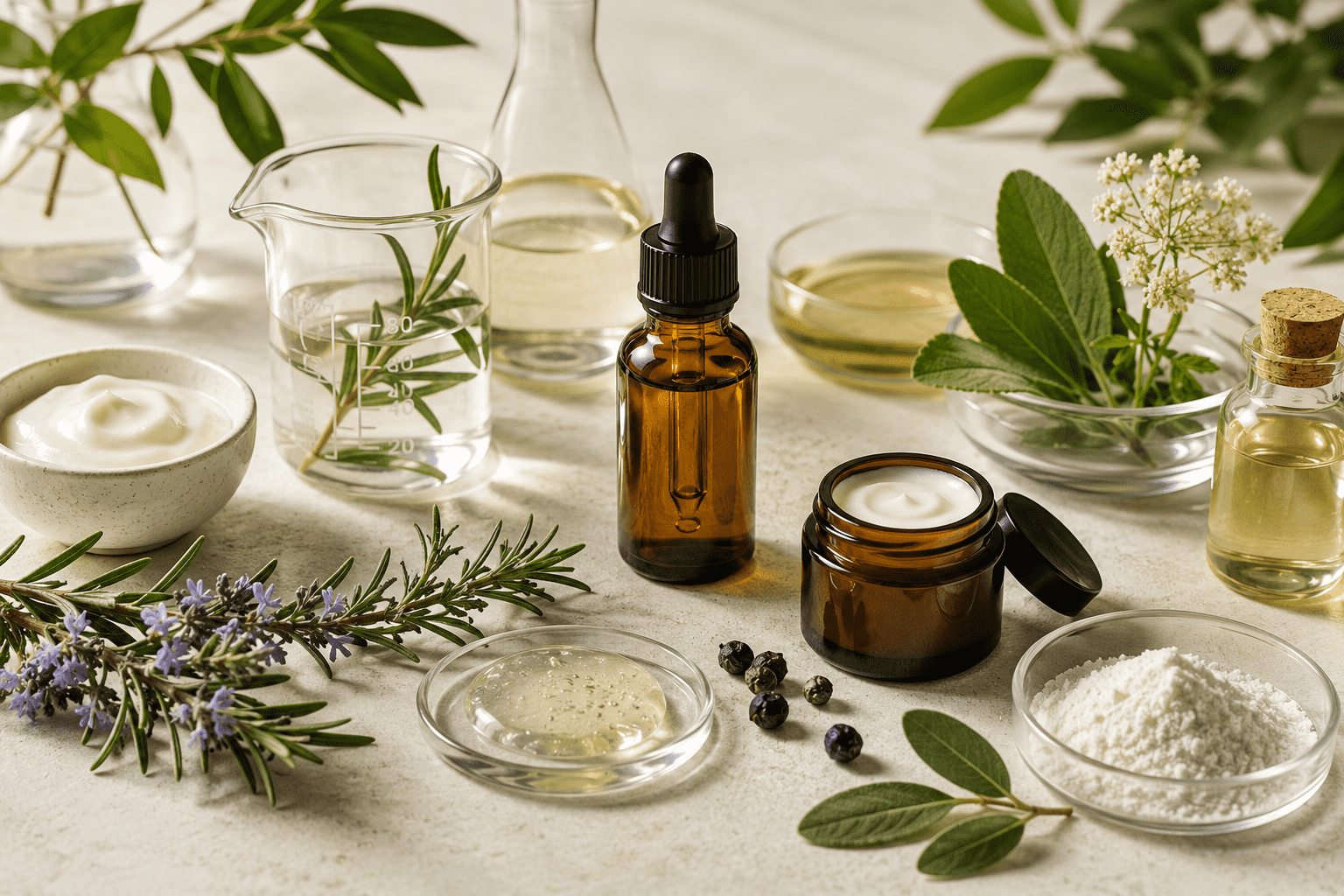
Consumers are becoming increasingly aware of what goes into their cosmetic products. Ingredient labels are scrutinised more than ever, and many people are actively looking for natural alternatives to conventional synthetic preservatives. The demand for natural cosmetics has grown significantly over the past decade, and with it comes a recurring question from formulators and consumers alike: can natural preservative systems actually protect a cosmetic product from microbial contamination? The honest answer is yes — under the right conditions, with the right formulation strategy. But the conditions matter more than the label.
This article examines the science behind natural preservatives for cosmetics — compounds found in nature or derived from plants and fermentation — their mechanisms, their real limitations, and what rigorous challenge testing actually reveals about their efficacy.
Interested in our products for cosmetics?
Head over to our product catalog to ask for documentation
Why cosmetics need preservatives at all
Most cosmetic products contain water. Emulsions, creams, lotions, gels, serums — any water-based product creates an environment where bacteria and fungi can grow. Without an effective preservative system, microbial contamination can occur both during manufacturing and during the product's use phase, as consumers repeatedly introduce microorganisms from their fingers and applicators. Contaminated products may show changes in color, odor, or texture, but microbial spoilage can also be invisible — making preservative efficacy a safety issue, not only an aesthetic one.
Cosmetics need to be safe for the entire period of use, which means formulators must prevent the growth of bacteria, yeasts, and molds from the moment of manufacture until the last application. Water-based products require preservatives because, once exposed to air and repeated handling, the growth of bacteria and other microorganisms can render a product unsafe within days of opening. Preservatives play a fundamental role in ensuring that the product is used safely from beginning to end and in extending the shelf life of the finished cosmetic.
ISO 11930, the internationally recognized challenge test standard for cosmetics, is built around this reality: it inoculates a finished formulation with five reference strains ( Staphylococcus aureus, Pseudomonas aeruginosa, Escherichia coli, Candida albicans, and Aspergillus brasiliensis) and measures microbial reduction at defined time points.
Anhydrous products — solid cosmetics, lipsticks, powders — present a fundamentally different risk profile. Without free water, microbial growth is effectively prevented, which is one reason the solid cosmetics movement represents a structurally simpler approach to preservation. But for the vast majority of conventional cosmetic formulations containing water, preservatives play an essential role in ensuring quality and safety and in extending their shelf life.
What makes a preservative "natural"?
The term "natural preservative" has no universal regulatory definition, which is itself part of the problem. In practice, it refers to antimicrobial compounds derived from natural sources — plants, fermentation processes, or natural organic acids — or to compounds that are nature-identical and accepted by certification bodies like COSMOS. This includes a wide range of substances: organic acids like sorbic acid and benzoic acid, botanical extracts with demonstrated antimicrobial activity, fermentation-derived compounds, and multifunctional glycols that reduce water activity.
Formulators looking for natural options often seek ingredients that are both stable and effective across the conditions of their specific formulation — a combination that is harder to guarantee with natural compounds than with conventional synthetic preservatives. What "natural" does not automatically mean is "effective at all pH levels," "broad-spectrum," or "sufficient as a single preservative." The efficacy of natural alternatives depends heavily on formulation context.
The main families of natural antimicrobial compounds
Organic acids: sorbic acid, potassium sorbate, benzoic acid
Organic acids are among the oldest preservatives used in both the food industry and cosmetics. Their mechanism of action is well understood: in their undissociated (protonated) form, they penetrate microbial cell membranes, disrupt the proton motive force, and acidify the cytoplasm, inhibiting growth. The critical constraint is pH. Organic acids can only pass through cell walls in their undissociated form, which means their antimicrobial efficacy drops sharply as pH rises toward neutral.
Sorbic acid and potassium sorbate are effective primarily against yeasts and moulds, with useful activity below about pH 6 and optimal activity closer to pH 5 and below. Sorbic acid was first isolated from the berries of Sorbus aucuparia (rowan) and is also produced naturally during fermentation, giving it legitimate natural credentials. otassium sorbate is the water-soluble salt form and is approximately 74% sorbic acid by weight, so a given weight delivers correspondingly less acid. Activity still depends on how much of that acid is present in undissociated form at the formulation pH. These compounds are not effective against bacteria at pH ranges common in skin-care emulsions, which limits their usefulness as a standalone preservative system.
Benzoic acid and sodium benzoate demonstrate broader spectrum antimicrobial activity, effectively inhibiting bacteria, yeasts, and molds through interference with microbial enzyme systems. At low pH, benzoic acid (pKa 4.20) exists largely in the undissociated state and readily crosses the cell membrane. Research published in PMC establishes minimum inhibitory concentrations of benzoic acid and sorbic acid against a range of spoilage microorganisms, confirming their efficacy at pH 4.5 to 5.0, where a meaningful fraction of the acid remains undissociated. Efficacy drops off sharply as pH rises: at pH 6.0, only around 1.5% of benzoic acid is in the undissociated, membrane-permeable form, so formulations in the upper part of this range need substantially higher use levels to achieve the same antimicrobial effect.
The implication for cosmetic formulators is direct: these organic acid preservatives work well in acidic skincare products (toners, serums, micellar waters), but their efficacy at higher pH — shampoos, cleansers, conditioners — is substantially reduced and may require a higher amount of preservative than is technically or aesthetically acceptable.
Plant extracts and botanicals: real activity, real variability
Polyphenolic compounds, essential oils, and plant extracts — reviewed in Pathogens (2023) — represent a broad and scientifically active area for natural cosmetic preservation. Their antimicrobial mechanisms include disruption of cell membranes, inhibition of enzymatic activity, and modulation of microbial growth pathways. These compounds are derived from plants and generally also contribute antioxidant and anti-inflammatory properties to the formulation, which adds functional value beyond simple preservation.
Rosemary extract is a well-studied example: research published in PMC confirms its antimicrobial and antioxidant activity, attributable primarily to phenolic compounds including rosmarinic acid and carnosic acid. These compounds help to reduce oxidative degradation in the formulation itself, making rosemary extract one of the rare natural preservative ingredients with a dual preservation and antioxidant role.
However, plant extracts carry practical challenges. Their composition varies with botanical origin, extraction method, and growing conditions — batch-to-batch consistency is harder to guarantee than with synthetic compounds. Many essential oils and botanical extracts are also strong sensitizers at the concentrations required for meaningful antimicrobial efficacy, limiting their use in leave-on products. Their use is also limited in products where colour and odour stability are critical, since high-concentration botanical extracts often affect these parameters.
A 2024 study published in Molecules evaluated a sugarcane straw extract-based ingredient for cosmetic preservation and demonstrated compliance with USP <51> challenge test standards at a 5% w/v concentration. This illustrates both the potential and the dose requirement: natural extracts often need to be incorporated at higher concentrations than conventional preservatives to achieve equivalent protection, with corresponding cost and formulation implications.
Antimicrobial peptides
Peptides with antimicrobial properties represent an emerging area in preservation research, though their adoption in cosmetics remains limited. Their mechanisms are well characterized — primarily membrane disruption — but stability in cosmetic formulations, cost, and regulatory clarity remain challenges. They are not yet a practical choice for most formulation teams, but they illustrate the direction of research in natural antimicrobial ingredients.
Benzyl alcohol
Benzyl alcohol occupies a grey area in the natural/synthetic debate. It is found in nature in many flowers and fruits, and functions as a preservative through disruption of microbial cell membranes, typically used at 0.5% to 2% in cosmetic formulations. Its activity is also pH-dependent, with reduced efficacy above pH 5.5. It is listed in the EU Cosmetics Regulation Annex V and accepted in COSMOS-certified formulations when naturally derived. However, benzyl alcohol is classified as a known fragrance allergen in the EU, which imposes additional labelling requirements.
The pH problem: why formulation context is everything
The single most important factor governing the efficacy of natural preservative systems is pH. Organic acids are primarily effective at pH below their pKa values. Sorbic acid (pKa 4.76) and benzoic acid (pKa 4.20) are both substantially undissociated and active at pH 4 to 5, but their antimicrobial concentration in undissociated form drops dramatically above pH 6.
This creates a structural constraint for natural preservative systems: they work best in products that are already acidic. A water-based emulsion at pH 6.5 to 7 — a common pH range for skin-compatible formulations — requires either higher concentrations of organic acids than are typically acceptable, the addition of pH-lowering agents to bring the formulation into the effective pH range, or a multifunctional preservation strategy that does not rely solely on organic acids.
Lowering the pH of the formulation is itself a legitimate preservation strategy: it increases the antimicrobial potency of any organic acid present and reduces the overall growth rate of most microorganisms. The type of product — its intended application, contact time, and target consumer — determines how low the pH can reasonably go while maintaining skin compatibility and stability.
Water activity: the anhydrous advantage
Water activity (Aw) is the measure of free water available to support microbial growth. At Aw below 0.75, most microorganisms cannot grow, and below 0.60 essentially none can — the thresholds used in ISO 29621:2017 for identifying microbiologically low-risk products. This means anhydrous or very low water-content formulations can achieve effective preservation without any chemical preservative.
Research on cosmetic preservation optimization demonstrated that the chemical structure of the glycol matters: propan-1,2-diol was more effective at reducing water activity than glycerin at equivalent concentrations, and the relationship between glycol concentration and water activity is not linear. For formulators targeting self-preserved cosmetics, measuring actual Aw of the finished formulation — rather than calculating from ingredient percentages — is necessary for reliable outcomes.
This approach is particularly relevant to the growing category of water-in-oil emulsions, very low water-content products, and concentrated actives where a combination of low Aw and mild organic acid concentration can replace conventional broad-spectrum preservatives.
Challenge testing: what the data shows
The challenge test under ISO 11930 is the definitive method for evaluating whether a preservative system is effective in a finished cosmetic product. It inoculates the product with calibrated microorganisms and measures reductions at days 7, 14 and 28, comparing results to acceptance criteria A or B. Criterion A requires the larger log reduction and is the target. Criterion B is the lower bar, and the standard accepts it only where additional justification shows the product is sufficiently protected, typically through packaging or conditions of use. It is not a default category for other formulations
The challenge test is not a formality. Natural preservative blends that appear effective in preliminary MIC testing — minimum inhibitory concentration in liquid medium — frequently underperform in real formulations at use concentrations. The formulation matrix changes everything: emulsifiers can bind antimicrobial compounds and reduce their bioavailability; the water phase may dilute effective concentration below the protective threshold; certain cosmetic ingredients can stimulate microbial growth by providing nutrients. A preservative system is effective only when confirmed by challenge testing in the actual finished formulation, not based on MIC data alone. Manufacturers must ensure their products pass this validation before launch.
Products making "preservative-free" or "natural preservation" claims still require ISO 11930 challenge test validation to demonstrate that hurdle technologies — low pH, reduced water activity, chelating agents, packaging design — together provide adequate microbial protection. Challenge testing is mandatory for water-based products across the EU and is expected for most other major markets.
Synergistic systems: the industry's practical response
Most effective natural preservative systems work through a combination of mechanisms — what formulators call a hurdle approach. Rather than relying on a single preservative compound at high concentration, the strategy stacks multiple mild antimicrobial inputs: acidic pH, a moderate concentration of organic acid, a glycol to reduce water activity, and possibly a botanical extract with complementary activity. The synergistic effect of combining mechanisms that target different aspects of microbial growth produces outcomes no single ingredient could achieve at acceptable concentration.
Using a variety of natural antimicrobial compounds in a blended system also reduces the risk of resistance development in microorganisms — a practical advantage that parallels reasoning in antibiotic combination therapy. Research on synergistic stabilizer combinations consistently shows that complementary mechanisms operating at different points in a degradation or growth pathway outperform any single mechanism alone.
For rinse-off products like shampoos and shower gels, requirements are generally lower than for leave-on skincare products like moisturizers and serums, since shorter contact time limits microbial exposure risk. This affects how much natural preservative concentration is needed and which combinations are appropriate for each type of product.
Regulatory framework: EU Annex V and what it means in practice
In Europe, cosmetic preservatives must appear on the positive list in Annex V of EU Cosmetics Regulation 1223/2009. Only substances on that list, at the specified maximum concentrations and conditions of use, can be legally used as preservatives. This constrains which "natural" compounds can be used: many plant extracts with genuine antimicrobial activity are not on the Annex V list and cannot be declared as preservatives, even if they contribute to microbial control.
The US Food and Drug Administration takes a different approach: it does not maintain a positive list of approved cosmetic preservatives, placing the responsibility on manufacturers to ensure that their products are safe and effective. This creates divergent formulation strategies for brands selling in both markets.
Under Regulation (EU) 2024/996, triclosan is not among the authorised uses in mouthwash, with new products required to comply from 31 December 2024 and existing products from 31 October 2025.
Do natural preservative systems really work?
The evidence-based answer is: yes, in the right formulations, validated by challenge testing. They are not universally applicable, and they are not a substitute for rigorous microbiological validation. One of the most effective approaches is not a single natural ingredient at high concentration, but a well-designed synergistic system validated at each pH range and for each type of product. The key constraints remain:
- pH dependency limits organic acid efficacy in neutral or alkaline formulations
- Broad-spectrum protection against both bacteria and fungi is harder to achieve with natural compounds alone
- Natural extracts vary in composition and require standardization
- Higher concentrations are often needed compared to synthetic preservatives, with cost and sensory implications
- The amount of preservative needed can increase significantly in formulations with higher water content or pH
For formulators working on water-based cosmetic products, the most robust natural preservation strategies combine pH optimization, organic acids, water activity control, and botanical extracts in a validated system — not a clean-label claim built on an ingredient at insufficient concentration.
Safic-Alcan's cosmetics and personal care portfolio
Safic-Alcan distributes a broad range of cosmetics and personal care ingredients, including natural and COSMOS-approved preservative systems, multifunctional glycols, emulsifiers, and botanical actives for formulation teams seeking effective natural preservation solutions across rinse-off and leave-on applications.
Explore our cosmetics and personal care catalog or contact our technical experts to discuss preservative system selection for your specific formulation.