


Drug release technologies have become a major driver of pharmaceutical innovation. A JAMA Network Open study of novel drugs approved between 1995 and 2021 found that nearly 40% were later reformulated, highlighting the growing role of formulation engineering in pharmaceutical innovation.[1]
While some release profiles are driven by API constraints, others are designed to improve patient experience. Meta-analyses show that patients receiving once-daily dosing had 22% to 41% more adherent days compared with patients receiving thrice-daily dosing. [2] In practice, this is more than just clinical nuance: for an equivalent efficacy, a medication that can be taken once a day instead of twice is preferred by patients and more likely to be prescribed. From an industry perspective, these differences can lead to improved product differentiation and stronger market adoption.
To illustrate this concept, let us explore how different oral solid dosage (OSD) formulations address specific patient, therapeutic, and formulation challenges through distinct drug release strategies.
Immediate release formulation: maximizing rapid drug availability
Following administration, an immediate-release (IR) dosage form rapidly disintegrates, releasing the API into gastrointestinal fluids for absorption in the upper gastrointestinal tract. It is particularly suited to APIs that are stable under gastric conditions and to therapeutic areas where a rapid onset of action is required. By minimizing the delay between administration and absorption, immediate-release formulations deliver fast therapeutic benefit and remain the benchmark for many oral solid dosage (OSD) products.
As the most common oral dosage form worldwide, immediate-release tablets are used in many of the world's best-known medicines, including paracetamol products.
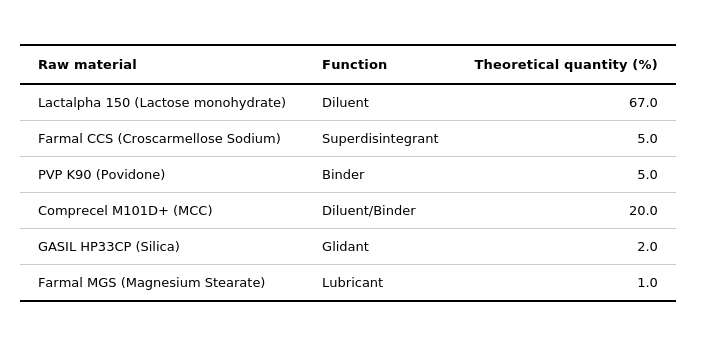
From the patient's perspective, the value is clear: rapid symptom relief and a simple dosing experience. For the formulator, however, achieving a rapid and reproducible drug release profile requires balancing several critical parameters, including disintegration time, tablet robustness, palatability, and API loading. A widely used combination includes lactose monohydrate as a filler, Povidone as a binder, and croscarmellose sodium as a Superdisintegrant. This combination allows fast drug release thanks to lactose monohydrate wettability and Croscarmellose sodium swelling properties while maintaining strong integrity due to Povidone high binding efficiency. Beyond excipient selection, their concentration is equally critical. Typically, binder concentration management directly influences compression behavior and, in fine, tablet performance.
The formulation shown below is an example of efficient immediate release composition.
For coated tablets, the challenge shifts to improving swallowability and handling without significantly delaying drug release. Ready-to-use coating systems such as Aquarius Genesis help achieve this balance by providing an elegant coating solution while simplifying processing for formulators and using less water per batch for a more eco-conscious formulation.
Sustained release formulation: extending therapeutic coverage
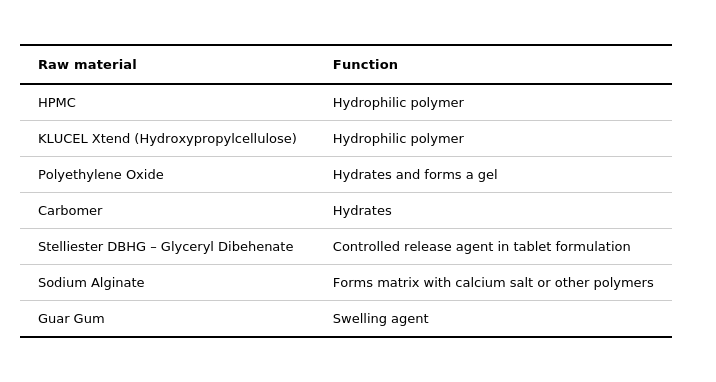
Sustained release is achieved by controlling the rate at which the API dissolves, diffuses, or leaves the dosage form thanks to a polymer matrix. When exposed to gastrointestinal fluids, the polymer hydrates and forms a gel layer around the tablet. This gel barrier regulates water penetration and API diffusion, allowing formulators to tailor the release kinetics according to therapeutic objectives. Additional polymers and matrix-forming agents can be combined to further adjust swelling, erosion, and release mechanisms.
The main excipients commonly used in sustained-release matrix systems are summarized below.
By reducing concentration peaks and delaying drug elimination, this approach can help maintain therapeutic efficacy while minimizing dose-related adverse effects which makes it particularly suitable for APIs with a short biological half-life, therapies requiring prolonged activity, or molecules with a relatively narrow therapeutic window. For example, some antiepileptic drugs are typically sustained release medication to avoid neurotoxicity while maintaining seizure control.
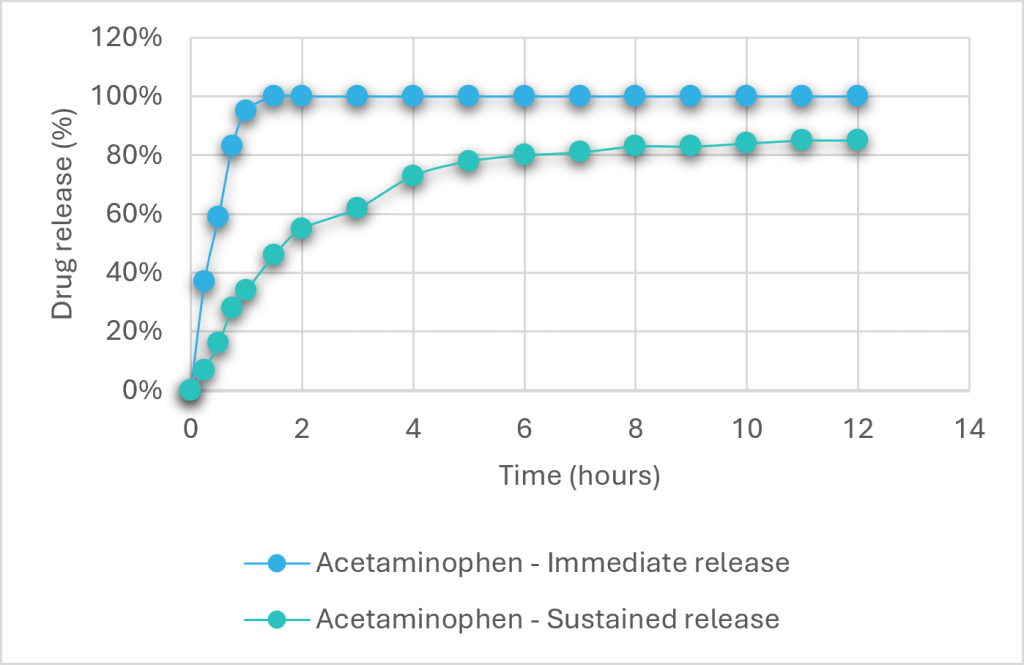
The impact of sustained release can be clearly illustrated by the dissolution study performed in our application laboratory. Compared with an immediate-release formulation, drug release occurs more gradually and remains incomplete over the same timeframe. After two hours, the immediate-release tablet had released 100% of its API, whereas the sustained-release formulation released less than 60%, avoiding the pic concentration.
While reducing dosing frequency can improve convenience, sustained-release formulations also introduce specific patient considerations. These dosage forms are generally not intended to be chewed, crushed, or split, as altering the tablet structure may significantly modify the release profile and compromise both safety and efficacy.
Enteric and Colonic Drug Release Achieved Through Tablet Film Coating
Functional film coating is a widely used strategy for targeting drug release to specific regions of the gastrointestinal tract. Among the most common applications are enteric release and colonic release, which make it possible to either protect the active ingredient or the stomach, and to deliver the drug to the colon before release of the active occurs.
Enteric Drug Release: protecting API and Optimizing Absorption
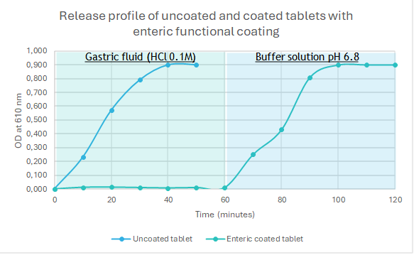
Some active ingredients cannot survive gastric acidity, and others irritate the stomach lining. Enteric coating with a methacrylic acid copolymer solves both problems at once. Impermeable below pH 5.5, the film dissolves as soon as the tablet reaches the duodenum (pH ≥ 5.5), releasing the active ingredient exactly where it needs to be.
For example, Omeprazole, one of the most prescribed drugs in the world, owes its therapeutic revolution in the 1990s precisely to this type of technology.
The performance of an enteric coating system largely depends on the selected polymer, weight gain and coating processes. Ensuring smooth film adhesion to the core tablets or pellets guarantees that the core will be protected from acidic conditions. This is why addressing the roughness of the tablet/pellet cores is important prior to the coating process. Commonly used enteric polymers include methacrylic acid copolymers hydroxypropyl methylcellulose phthalate (HPMCP), hydroxypropyl methylcellulose acetate succinate (HPMCAS), and cellulose acetate phthalate (CAP).
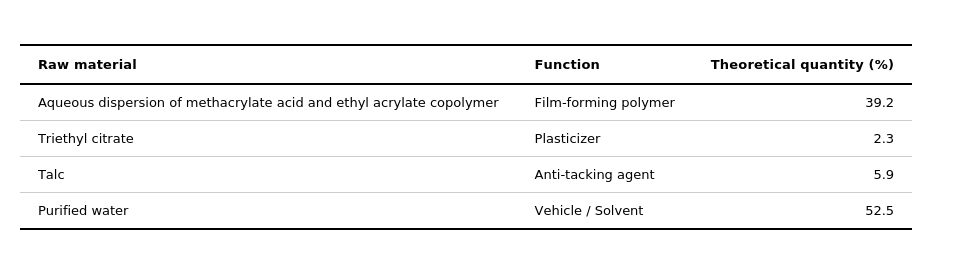
One of the easiest ways to perform enteric coating is to simply resuspend in water a ready to use mixture of methacrylic acid copolymers, like Aquarius Control ENA, and apply to the tablets or pellets. It is also possible to formulate internally the entire coating suspension (example showcased on the table below).
After coating, tablets or pellets disintegration profile needs to be compliant with USP <701> or European pharmacopeia 2.9.1. An example performed internally is showcased on the graph below.
Colonic Drug Release : Precision Targeting through functional coating
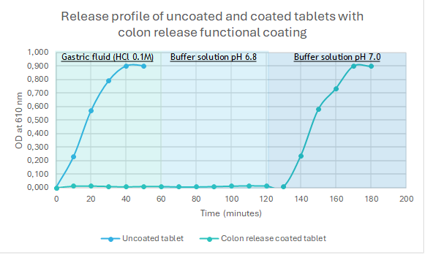
Reaching the colon by oral route is a precision challenge. Methyl methacrylate-based copolymer sensitive to neutral-to-slightly-alkaline pH (dissolution from pH 7) enables targeted release in the distal colon. Which is ideal for inflammatory bowel diseases (IBD) such as ulcerative colitis, where local action takes precedence over systemic delivery.
For example, Mesalazine with colonic release, developed in the 1990s, significantly reduced the systemic side effects of IBD treatments, opening a new era in digestive pharmacology.
Colon targeting can be achieved through several coating strategies:
- pH-dependent systems, using polymers that dissolve only at higher pH values, typically above pH 7.
- Time-dependent systems, where film coating controls the lag time prior to drug release.
Colonic coating technologies help minimize drug exposure in the upper gastrointestinal tract, improve local therapeutic efficacy, and reduce systemic side effects.
An example of colon release coating formulation is described below, as well as an example of tablet disintegration results after colon coating.

Your Formulation Partner for Precision Drug Release
Precision drug release is a strategic lever for both clinical innovation and commercial success. Each release approach addresses specific therapeutic, patient, and formulation challenges, creating opportunities for product differentiation in an increasingly competitive pharmaceutical market. As your partner in innovation, Safic-Alcan combines formulation expertise with a broad portfolio of excipients and technologies to help transform patient needs into effective, high-performing drug products.
Discover our reliable excipients and APIs meeting stringent pharmaceutical standards.
REFERENCES
[1] Approvals and Timing of New Formulations of Novel Drugs Approved by the US Food and Drug Administration Between 1995 and 2010 and Followed Through 2021
[2] Effect of medication dosing frequency on adherence in chronic diseases.The American Journal of Managed Care, 01 Jun 2009