


This article is the formulation companion to What 'glass skin' actually is — the formulation trend explained, which covers the market trend, consumer context, and skin biology behind the aesthetic. This piece focuses on ingredient class selection, mechanism, trade-offs, and sourcing considerations.
TL;TR
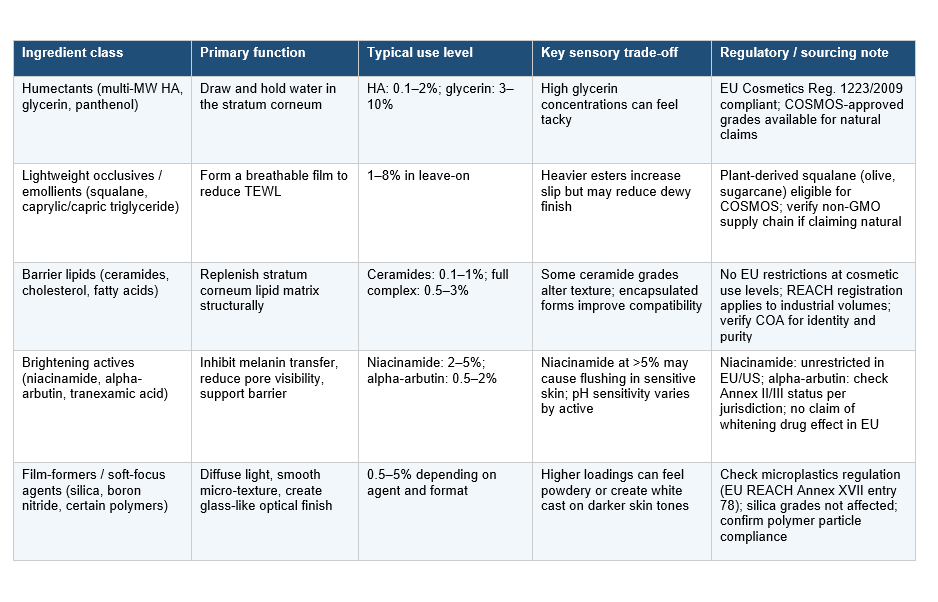
Formulating for a glass-skin finish means combining five ingredient classes in sequence: humectants to load the stratum corneum with water, lightweight occlusives to seal it, barrier lipids to structurally restore the stratum corneum lipid matrix, brightening actives to even tone and reduce pore visibility, and film-forming or soft-focus agents to produce the optical finish. No single class delivers the result alone. The formulation challenge is layering them at effective concentrations without compromising sensory profile, stability, or regulatory compliance across target markets.
Interested in our products?
Safic-Alcan distributes humectants, squalane, ceramide, and niacinamide for cosmetics applications
The formulation problem
Glass skin is produced by two physical conditions acting together: high water content in the stratum corneum, and an intact lipid barrier that limits transepidermal water loss (TEWL). A formulation targeting this finish therefore has to address both conditions simultaneously, across three time horizons:
- Immediate effect: a visible plumping and smoothing that the consumer notices within minutes of application.
- Short-term durability: the finish persists for several hours rather than fading once product absorption is complete.
- Cumulative skin improvement: repeated use builds barrier integrity and reduces TEWL over days and weeks, making the base condition easier to achieve with each application.
These three requirements map onto different ingredient classes. Humectants drive the immediate effect. Occlusives and barrier lipids together extend durability. Barrier lipids — particularly ceramide classes — drive the cumulative improvement. Brightening actives and soft-focus agents complete the aesthetic.
Ingredient class overview
Humectant classes: loading the stratum corneum with water
Humectants work by attracting water from the environment and the dermis below into the upper skin layers. In glass skin formulations, the most widely used humectant class is hyaluronic acid (HA), followed by glycerin, panthenol, and polyols such as butylene glycol.
Hyaluronic acid: why molecular weight determines performance
Hyaluronic acid in its natural form spans a molecular weight range from approximately 4,000 Da to 8,000,000 Da. In cosmetic applications, the stratum corneum acts as a size-selective filter: high-molecular-weight HA (above 1,000 kDa) stays at the surface, while low-molecular-weight fractions below 100 kDa penetrate into the epidermis. This is confirmed by Raman spectroscopy studies published in 2015 (Piot et al., Skin Research & Technology) and by a 2023 study in JOJ Dermatology & Cosmetics (Giardina & Poggi) which found that fractions below 100 kDa penetrate completely into epidermis and dermis after topical application.
The practical formulation consequence is that using a single molecular weight fraction delivers one type of hydration benefit at one depth. Multi-molecular-weight HA systems — blending high, medium, low, and ultra-low fractions — distribute hydration across all layers simultaneously. This is why multi-MW blends have become the default in glass skin serums and essences.
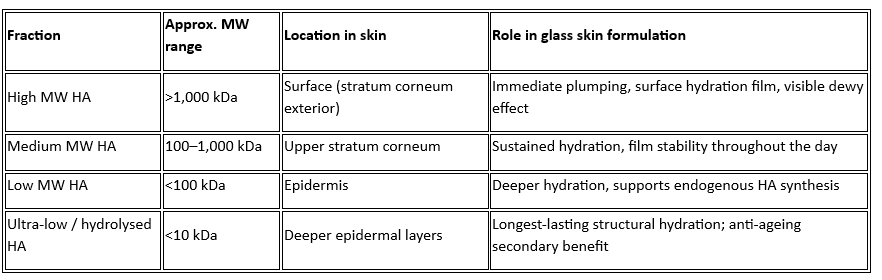
Note on INCI nomenclature: all molecular weight variants of HA are listed as Sodium Hyaluronate on the ingredient label. The INCI name alone does not indicate which fraction or blend is present, which means COA verification of MW range is necessary when specifying grades from suppliers.
Glycerin and other polyols
Glycerin is the most cost-effective humectant available and is effective at concentrations from 3% to 10% in leave-on formulations. At concentrations above 10%, finished formulas can feel tacky, which conflicts with the clean, non-residue sensory expectation of glass skin products. Glycerin also has a documented interaction with niacinamide: increasing glycerin concentrations reduce niacinamide skin penetration, a trade-off that formulators using both together should manage through concentration and vehicle design.
Panthenol (provitamin B5) is a secondary humectant that also contributes to wound healing and skin barrier support. Butylene glycol and propanediol are frequently used as co-humectants and as solvents for actives, improving compatibility without the tackiness risk of high glycerin levels.
Lightweight occlusive and emollient classes: sealing in hydration
Occlusives reduce TEWL by forming a physical film over the stratum corneum surface. For glass skin formulations the key requirement is that this film be lightweight, non-greasy, and non-comedogenic — a heavy occlusive layer produces a different aesthetic (more typical of a barrier cream) and is incompatible with the dewy-but-not-greasy finish the trend demands.
Squalane
Squalane is a saturated hydrocarbon with a molecular weight of 422.8 g/mol. It is structurally similar to the squalene present in human sebum, which is why it integrates readily into the skin lipid matrix without disrupting its function. In vitro studies show squalane reduces TEWL by up to 25%, and it has a comedogenicity rating of 0–1 on the standard scale, making it suitable across all skin types including acne-prone skin. Its fast absorption (under 30 minutes in reported studies) and odourless, colourless profile make it a technically clean vehicle for actives such as retinol, tocopherol, and peptides.
Plant-derived squalane (olive, sugarcane, amaranth) is eligible for COSMOS certification and positions well with the clean beauty positioning that the glass skin trend carries. Verify the botanical source and request a non-GMO declaration if the formulation makes natural-origin claims, and confirm peroxide value and colour in each batch — these are the primary stability indicators for this class.
Caprylic/capric triglycerides and ester classes
Caprylic/capric triglyceride (INCI: Caprylic/Capric Triglyceride) is a medium-chain triglyceride derived from coconut oil or palm kernel. It is lighter than squalane in feel, has excellent spreadability, and is commonly used to adjust texture in glass skin emulsions and serums where a more fluid sensory profile is required. Heavier esters — cetyl palmitate, isopropyl myristate — increase slip and spreadability but shift the finish away from the dewy, lightweight profile the category expects.
Barrier lipid classes: structural repair of the stratum corneum
Barrier lipids are the ingredient class that produces cumulative improvement in glass skin over time. They replenish the lipid matrix of the stratum corneum directly, restoring the 'mortar' between corneocytes that controls TEWL and maintains skin smoothness.
Ceramides
Ceramides are the dominant lipid in the stratum corneum, comprising approximately 50% of the intercellular lipid content by mass. Topically applied ceramides replenish this matrix. A randomised clinical trial published in 2024 (ScienceDirect) demonstrated significant improvement in TEWL and skin hydration across 89 dry-skin subjects after 28 days of use of formulations containing ceramides and niacinamide. Research published on PubMed (Chamlin et al.) also showed that ceramide-dominant barrier repair formulations improve atopic dermatitis, a condition defined by barrier dysfunction.
Multiple ceramide sub-types exist (NP, AP, NS, EOP, and others). These types differ in head group chemistry and fatty acid chain length. Effective barrier repair formulations typically use a complex of several types rather than a single ceramide, which better replicates the heterogeneous composition of the natural stratum corneum lipid matrix. Encapsulated ceramide systems improve dispersion in aqueous formulations and can reduce the texture impact that some ceramide grades introduce.
Cholesterol and fatty acids
The stratum corneum lipid matrix contains ceramides, cholesterol, and free fatty acids in a roughly 1:1:1 molar ratio. Formulations that use ceramides alone, without cholesterol and fatty acids, produce less complete barrier repair than those that replicate the full lamellar structure. At formulation level, cholesterol (typically from lanolin, phytosterol, or synthetic sources) and fatty acids such as linoleic acid or palmitic acid are used to complete the complex.
Note that niacinamide supports endogenous synthesis of ceramides, free fatty acids, and cholesterol in keratinocytes, confirmed in randomised clinical trials reviewed in Cosmoderma (2026). This is one reason the niacinamide-ceramide combination appears consistently across glass skin formulations.
Brightening active classes: tone, pore visibility, and barrier support
The glass skin look requires even skin tone as well as hydration: pore visibility, dark spots, and uneven pigmentation break the uniform light-reflection that produces the glass-like effect. Brightening actives address this at different points in the melanin pathway.
Niacinamide
Niacinamide (vitamin B3) inhibits the transfer of melanosomes from melanocytes to keratinocytes — the mechanism behind its brightening effect (Hakozaki et al., 2002, cited in Practical Dermatology). Clinical studies consistently show significant improvement in skin brightness and sebum regulation at concentrations between 2% and 5%. At 5%, a Procter & Gamble trial demonstrated reduction in hyperpigmentation and improved barrier function simultaneously. It is a precursor for NAD+, which is required for cellular energy metabolism and DNA repair — explaining its secondary effects on barrier integrity and skin ageing.
Formulation pH should be maintained between 5.5 and 7 to avoid conversion of niacinamide to niacin, which can cause flushing. At high glycerin concentrations, niacinamide skin penetration is reduced, a trade-off to manage in multi-humectant formulas. Niacinamide is unrestricted under EU Cosmetics Regulation 1223/2009 and is compatible with COSMOS-approved formulations. Avoid drug-effect language ('whitening', 'skin lightening') in EU and UK marketing.
Alpha-arbutin and tranexamic acid
Alpha-arbutin inhibits tyrosinase activity upstream in the melanin synthesis pathway. It is effective at 0.5–2% in leave-on formulations and is generally well tolerated. Regulatory status varies by jurisdiction: confirm current Annex II and III position for target markets before launch, particularly for APAC markets where brightening active regulations differ from the EU framework.
Tranexamic acid works by inhibiting UV-induced plasmin activity, which triggers melanocyte stimulation. It is used at concentrations between 2% and 5% and is gaining prevalence in glass skin serums because it addresses post-inflammatory hyperpigmentation without the irritation risk associated with retinol or acid exfoliants.
Film-former and soft-focus agent classes: the optical finish
The final layer in a glass skin formulation determines the immediate optical effect. Film-formers smooth micro-texture at the surface; soft-focus particles diffuse light to minimise the appearance of pores, fine lines, and uneven texture. This class produces the 'glass' appearance visible immediately after application.
Platelet particles: boron nitride and mica
Boron nitride and mica are platelet-shaped mineral particles. Their flat geometry allows them to lie parallel to the skin surface, creating a mirror-like light reflection rather than the omni-directional diffusion produced by spherical particles. This makes them the reference for a truly glass-like reflective finish. Boron nitride has an additional skin-feel benefit: it is silky and low in friction, which contributes to the smooth surface feel associated with the aesthetic. These are not subject to the EU REACH Annex XVII microplastics restriction (entry 78), which targets synthetic polymer particles only.
Spherical silica
Spherical silica (INCI: Silica) diffuses light more broadly than platelet particles, creating a soft-focus effect that reduces the appearance of texture without the mirror reflection. At lower loadings (0.5–2%) it contributes to the glass skin finish without making the formulation feel powdery. At higher loadings, a chalky or white-cast effect can appear, particularly on medium and darker skin tones. Silica is not subject to the EU microplastics restriction.
Polymer-based film-formers
Certain acrylate and polyurethane film-forming polymers can improve surface smoothing and extend wear of the glass skin effect. Formulators should verify compliance with EU REACH Annex XVII entry 78 for any synthetic polymer particle used in leave-on formulations, as this restriction applies to particles below 5 mm in a range of product categories. Confirm particle size, shape, and solubility status with the supplier before specifying.
How to choose: a decision framework by skin profile and format
The five classes above need to be balanced against three axes: the target skin profile (dry and compromised vs. oily and resilient), the product format (serum vs. essence vs. moisturiser), and the regulatory and marketing positioning (conventional vs. COSMOS natural).
- Dry or barrier-compromised skin: prioritise ceramide complex and cholesterol/fatty acid co-ingredients for structural repair. Use a multi-MW HA system for layered hydration. Squalane at 4–8% is appropriate at this skin profile. Limit soft-focus agent loading to avoid the powdery feel that conflicts with the richer sensory profile this formulation requires.
- Oily or blemish-prone skin: reduce total emollient and occlusive level. Caprylic/capric triglyceride is preferable to squalane at this profile (lighter, faster-absorbing feel). Keep niacinamide at 4–5% for sebum regulation. Use spherical silica over platelet particles for a more matte-adjacent finish that controls shine without eliminating luminosity.
- Serum format: lower viscosity, higher active loading. Multi-MW HA at 0.5–2%, niacinamide at 4–5%, squalane at 1–3%, soft-focus agents optional. Film-formers can be used sparingly to extend wear.
- Moisturiser format: higher emollient phase allows ceramide complex at 0.5–3% more readily. Glycerin at 3–8% as primary humectant; HA as secondary at lower concentration. Platelet particles at 0.5–2% for finish.
- COSMOS-positioned formulation: specify plant-derived squalane with COSMOS certification; COSMOS-approved HA grades exist (fermentation-derived, no animal origin). Check each actives and film-forming agent against the COSMOS-standard positive list. Soft-focus minerals (silica, boron nitride) are approved as mineral ingredients.
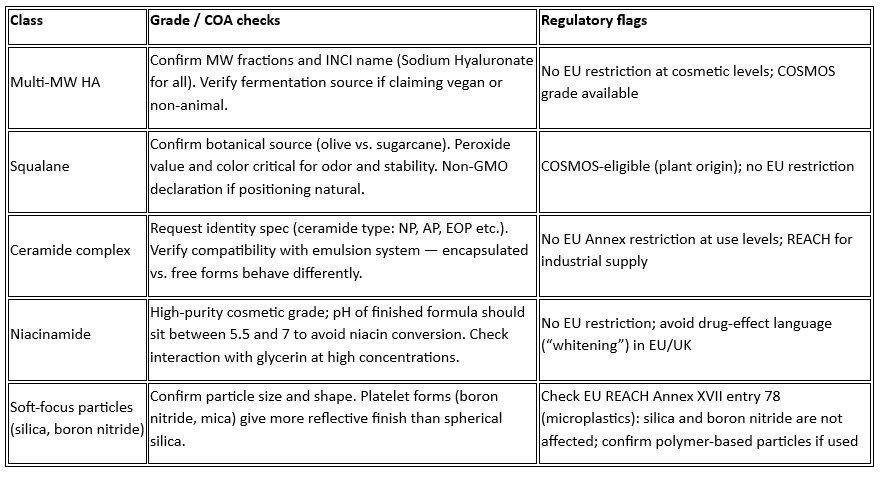
Sourcing and grade checklist
FAQ — practitioner phrasing
What multi-MW HA ratio works best for a glass skin serum?
There is no single validated ratio in peer-reviewed literature. The functional logic is: a dominant high-MW fraction (>500 kDa) for the visible surface film effect, a medium fraction (100–500 kDa) for durability, and a low-to-ultra-low fraction (<100 kDa) for depth and cumulative benefit. A common starting point is 60:30:10 by weight between these tiers, with total HA at 0.5–2% of the formula. Actual performance should be confirmed by TEWL measurement under your emulsion system.
Should we use free ceramides or encapsulated ceramides?
Free ceramide grades are less expensive but can be difficult to disperse in aqueous systems and may affect texture at higher use levels. Encapsulated ceramides (liposomal or nanoparticle delivery) improve dispersion, reduce interaction with other formula components, and can improve skin penetration. If the formulation is a serum or lightweight emulsion, encapsulated ceramide systems are often the more technically straightforward choice. Free ceramide complexes in an oil phase work well in richer moisturiser formats where the emollient phase can accommodate them.
Can niacinamide and vitamin C be used together in a glass skin formula?
The historical concern — that niacinamide and ascorbic acid (vitamin C) form a yellow nicotinic acid complex at high temperatures — has been substantially revised. At the concentrations and temperatures used in cosmetic formulations, this reaction is very slow and its product is not harmful. The more practical constraint is pH compatibility: ascorbic acid is stable at pH 3–3.5, while niacinamide performs optimally above pH 5.5. Formulating both in the same product therefore requires a compromise pH (around 4–5) or the use of stabilised vitamin C derivatives (ascorbyl glucoside, sodium ascorbyl phosphate) that are stable at higher pH and compatible with niacinamide without a compromise.
What does the EU microplastics restriction (REACH Annex XVII entry 78) mean for soft-focus particles?
EU REACH Annex XVII entry 78, which restricts the use of synthetic polymer particles in certain product categories, does not apply to inorganic mineral particles such as silica, boron nitride, or mica. It applies to synthetic polymer particles — acrylates, polyurethanes, nylons, and similar — that are not readily biodegradable. If you are using any polymer-based film-former or soft-focus agent, verify with your supplier whether the restriction applies, based on particle size, composition, and solubility. The regulation entered into force in October 2023 with phase-in timelines by product category. For up-to-date status, consult the ECHA guidance and confirm with your regulatory team.
How do we validate that our formula achieves a glass skin finish?
No single standardised test defines 'glass skin.' A practical validation protocol should include: TEWL measurement (corneometer or Tewameter) before and after application to confirm occlusive and humectant efficacy; skin hydration measurement (Corneometer) at 0, 1, 4, and 8 hours post-application to confirm durability; instrumental colour analysis for tone-evening actives (Mexameter or spectrophotometer, Melanin Index over 4–8 weeks); and visual or photographic assessment of surface finish using standardised lighting to capture the reflective quality. Volunteer studies at 28 days are sufficient to detect ceramide-driven barrier improvement.
Is there a COSMOS-compliant route to a glass skin formulation?
Yes. Plant-derived squalane from olive or sugarcane origin is COSMOS-eligible. Fermentation-derived HA grades with COSMOS approval exist. Ceramides derived from plant sources (phytosphingosine-based) are accepted. Niacinamide is typically accepted as a chemically processed agro-ingredient under COSMOS. The main constraint is soft-focus particles: mineral silica and boron nitride are approved as mineral ingredients; polymer-based film-formers are generally excluded. COSMOS also limits synthetic preservatives, which affects the broader formulation rather than the glass skin ingredient selection specifically.
Interested in our products?
Safic-Alcan distributes humectants, squalane, ceramide, and niacinamide for cosmetics applications