


The microplastics restriction is often summarised as a ban on glitter and scrub beads. It is much wider than that. Regulation (EU) 2023/2055 restricts synthetic polymer microparticles on their own and when intentionally added to products, with transition periods running up to twelve years (Freshfields). For a cosmetic brand, the practical question is which of your formulas are caught, and by which date. This guide sets out the calendar and how to audit a formula against it.
Quick answer
- The restriction sits in REACH, as entry 78 of Annex XVII, and applies above 0.01% by weight.
- Microbeads used to exfoliate, polish or clean were banned with no transition period, from 17 October 2023.
- Rinse-off cosmetics: 17 October 2027. Leave-on cosmetics and encapsulated fragrances: 17 October 2029.
- Make-up, lip and nail products: labelling from 17 October 2031, restriction from 17 October 2035.
- Reformulation is only half the work: the documentation trail from your suppliers is the other half.
What counts as a microplastic here
The regulation does not restrict "plastic" in the everyday sense. It restricts synthetic polymer microparticles, defined by size, composition and solubility, present to give the product a sought-after characteristic, above a threshold of 0.01% by weight (Intertek). Several exclusions exist, including polymers that are biodegradable or soluble under defined test conditions, and particles contained by technical means that prevent release during use (EU Verify).
Two consequences follow. First, an ingredient is not caught because its INCI name sounds like a plastic: it is caught because it meets the definition. Second, the opposite is also true, which is why formulators are often surprised by film formers, opacifiers, texture agents and bulking agents that do fall in scope.
The calendar
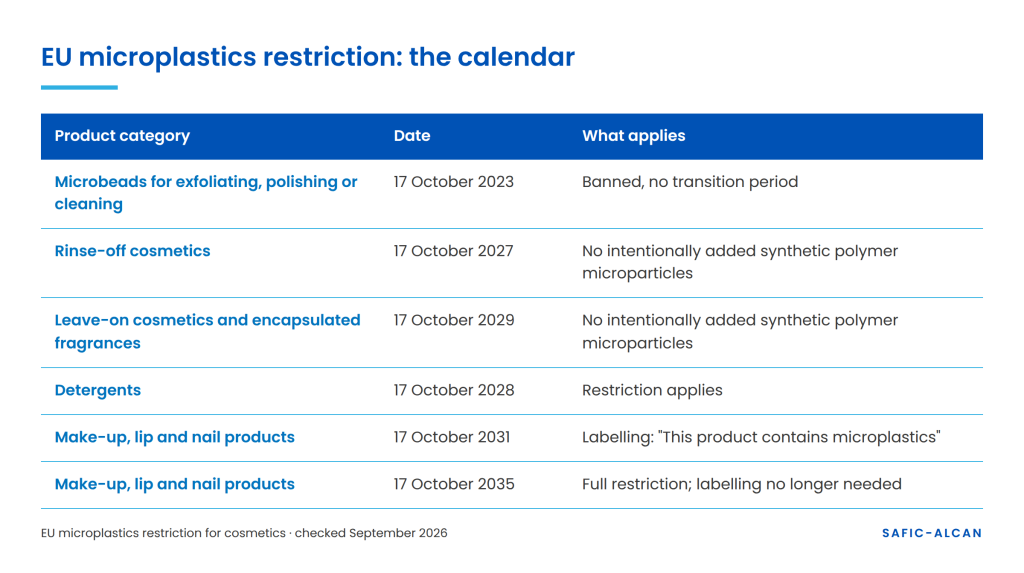
Sources: Freshfields, Intertek, REACH24H and Compliance Gate. Dates checked in September 2026: verify against the current text of entry 78 before making a compliance decision, as secondary summaries do not all agree.
Need to know whether an ingredient is caught?
Send us the INCI list of the formulas you are worried about. Safic-Alcan will request the supplier position on each polymer we distribute.
How to audit a formula
- List the polymers, not just the ones that look like plastic: film formers, opacifiers, texturisers, bulking agents, exfoliating particles, glitter and encapsulated fragrance systems.
- Ask each supplier one question in writing: does this material contain synthetic polymer microparticles within the meaning of entry 78, and on what evidence?
- Sort your portfolio by date, not by product. Rinse-off first, leave-on next, make-up last.
- Check the alternatives against the same definition, including the biodegradability or solubility evidence, so you do not reformulate twice.
- Update the documentation: the safety report, the product information file and any claim that touches on the ingredient.
The supplier answers are the part that takes longest, and they are exactly what a safety assessor will ask for. Our CPSR documents checklist shows how to request them once rather than three times. For the other changes arriving in the annexes of the Cosmetics Regulation, see what is changing in the EU Cosmetics Regulation, and for the wider REACH picture, our REACH 2026 update.
Where reformulation usually starts
In practice, three families account for most of the work in cosmetics: exfoliating and optical particles, film formers, and thickening or texturising polymers. The first is largely settled, since microbeads went in 2023. The second and third are where the 2027 and 2029 dates bite, because the replacement has to match both performance and sensory profile. Our guide to rheology modifiers in cosmetics covers the natural and synthetic options for the texture side.
One planning point: 2027 is not far away for a portfolio of any size. Reformulation, stability, compatibility and safety assessment take longer than the formulation trial itself, and the supplier documentation has to arrive before the assessor can finish. Brands that started with an INCI audit across the whole range are the ones with a calendar rather than a queue.
Planning your reformulation before October 2027?
Safic-Alcan can help you map the ingredients concerned and propose alternatives available in your market.
Frequently asked questions
Is glitter banned in the EU?
Loose plastic glitter and microbeads used to exfoliate, polish or clean were restricted from 17 October 2023, with no transition period. Other uses follow the staggered calendar by product category.
When do rinse-off cosmetics have to comply?
From 17 October 2027 for intentionally added synthetic polymer microparticles above 0.01% by weight.
What about leave-on products?
From 17 October 2029, which also covers encapsulated fragrance systems.
Are make-up and lip products exempt?
No, they have the longest transition. From 17 October 2031 they must carry the statement that the product contains microplastics, and from 17 October 2035 the restriction applies in full.
Does a biodegradable polymer count as a microplastic?
Polymers that meet the biodegradability or solubility criteria set out in the restriction are excluded, but the exclusion has to be demonstrated with the test evidence defined in the text. Ask your supplier for that evidence rather than assuming it.