


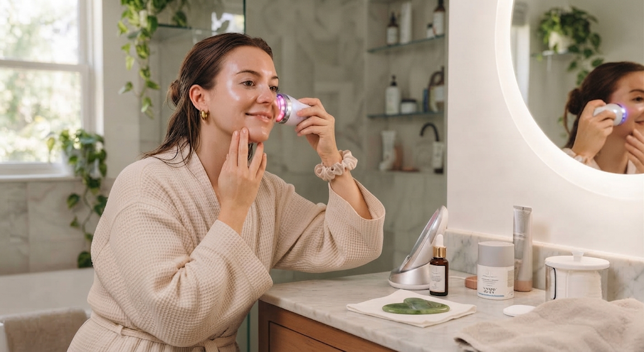
How Technology is Redefining Skin Longevity
Consumers no longer expect skincare to rely on formulas alone. They are looking for personalized, technology-enhanced routines that deliver measurable results, extend skin health and support long-term skin longevity.
From LED therapy and microcurrent to radiofrequency, ultrasound and AI-powered diagnostics, beauty devices are rapidly becoming an integral part of modern skincare ecosystems. Their success depends on one essential element: the cosmetic formulation used alongside them.
An interview with Nuon
Safic-Alcan's partner for next-generation beauty devices
Speaker Nuon : Alain Dijkstra
Alain Dijkstra's fascination with light therapy began after witnessing a device visibly ease his grandfather's tremors within minutes, sparking a deep dive into phototherapy and medical device technology. Drawing on years of experience in China's manufacturing and tech landscape, he founded Nuon Medical to bring clinical-grade light therapy, microcurrent, and other advanced modalities into everyday beauty applications, and under his leadership, the company has become known for engineering high-performance applicators that meet rigorous technical standards while staying accessible for at-home use.
Skincare is shifting from correction to prevention, and beauty devices sit right at the center of that shift. Consumers today want more than a promise on a label, they want visible, measurable results, and technologies like phototherapy, microcurrent, and EMS bring that clinically supported efficacy into daily routines. Instead of addressing concerns after they appear, people are building consistent, preventive habits designed to protect skin health over years, not weeks.
At-home devices also let people bring professional-grade routines into their own bathrooms, making advanced skincare a daily habit rather than an occasional treatment. This consistency is exactly what long-term skin health and healthy ageing require, small, repeated actions compounding over time.
Layer in personalization and connected beauty, where devices and formulations are designed to work together and adapt to individual skin needs, and it's clear why devices are no longer an add-on. They're becoming a core pillar of how people care for their skin, alongside the formulations and ingredients that have always defined skincare.
Texture and technology have to be engineered together, because the wrong formulation can limit a device's performance entirely. Microcurrent works best with conductive gels that carry the current evenly across the skin, while radiofrequency benefits from medium-viscosity gels that help the device glide smoothly without losing contact. Ultrasound relies on coupling gels to transmit energy efficiently, and LED responds well to lightweight serums that won't block light penetration.
Electroporation calls for water-based serums that support ingredient delivery through temporarily opened pathways, while cryotherapy performs best with refreshing gel textures that enhance the cooling sensation and comfort. Glide and roller-based devices, meanwhile, pair naturally with oils and rich emulsions that provide slip and glide for a smoother, more comfortable experience.
This is exactly where formulation expertise and device engineering meet: the right texture doesn't just support a device, it can determine whether the technology performs as intended at all.
AI is set to turn beauty devices from static tools into truly adaptive skincare partners. AI-powered skin analysis will allow devices to assess conditions in real time, and that data will feed adaptive treatment protocols that adjust intensity, duration, or frequency based on what the skin actually needs that day, rather than a one-size-fits-all setting.
We'll also see the rise of connected beauty ecosystems, where devices, apps, and formulations communicate with each other to create a cohesive routine. Learning algorithms will track results over time, refining personalized dosage recommendations as skin responds and changes. Smartphone integration will make this intelligence accessible and easy to act on, putting real-time guidance directly in the user's hands.
Perhaps most exciting is predictive skincare, using data patterns to anticipate concerns before they become visible, shifting the entire category further toward prevention. Over the next five years, AI won't just personalize skincare, it will make it proactive.
The face has long been the primary focus, but attention is rapidly expanding to other areas with real innovation potential. Scalp health and hair density are gaining momentum, with applicators supporting circulation and follicle health as part of daily routines. The neck and body are following the same logic as facial skincare, visible signs of ageing that consumers now want to address preventively, not just correctively.
Eye contour and lips are also emerging as focus areas, since these delicate zones show ageing early and benefit from targeted, gentler technologies. Intimate wellness is becoming a more open, destigmatized category too, with phototherapy showing particular promise for gentle, non-invasive care in this space.
This is very much where we see the next frontier: expanding proven beauty technologies like phototherapy, microcurrent, and EMS into applicators built specifically for each of these zones, rather than adapting one device to fit everywhere.
Sustainability is no longer a secondary consideration in device design, it's shaping decisions from the very first sketch. Rechargeable systems have become standard, reducing single-use battery waste while giving devices a longer, more useful lifespan. Designing for repairability is gaining ground too, so devices can be maintained and extended rather than replaced at the first sign of wear.
As medical-grade technology, our focus is on reusability and longevity rather than disposability, building devices meant to last years, not seasons, and engineering energy efficiency directly into components without compromising performance. On the formulation side, refillable conductive gels are helping cut packaging waste while keeping devices working at their best.
All of this reflects a broader shift toward eco-design as a starting principle, not an afterthought. The most forward-looking beauty tech innovation today asks not just "does it work," but "does it last, and can it be responsibly made, used, and eventually replaced."
By 2035, we believe skincare will move away from buying products individually and toward a connected ecosystem built around the individual, not the shelf. Diagnostics will identify what skin actually needs, AI will interpret that data and adapt over time, and beauty devices and formulations will be designed to work together from the outset rather than being paired after the fact.
This doesn't mean fewer choices, it means smarter ones. Consumers will still choose formulations and technologies that suit their preferences, but the routine itself will be guided by real data rather than trends or trial and error. Skin longevity will become the goal, supported by consistent, personalized care rather than one-off purchases.
For us, this future reinforces why applicators and formulations can no longer be developed in isolation. The ecosystem approach isn't a distant vision, it's already the direction the industry is moving.
Where Can You Experience These Technologies?
Experience the future of skin longevity in action. Across our upcoming exhibitions and customer days, you'll be able to explore Nuon's beauty devices alongside Safic-Alcan formulations specifically developed to complement each technology.
📍 Poland | HPCI Exhibition
September 23-24, 2026
Discover the experience → HPCI CEE 2026 | Discover Ever-Adaptive Beauty with Safic-Alcan
📍 Egypt | Customer Day
October 12, 2026
Register now → Adaptive Beauty Ingredients Event – Cairo, Oct 2026
📍 DACH | SEPAWA Exhibition
October 14-16, 2026
Meet us there → SEPAWA Congress 2026: Treffen Sie Safic-Alcan
📍 BNL | Customer Day
October 29, 2026
Learn more → Ever-Adaptive Beauty: Designing beauty solutions
📍 Italy | Making Cosmetics Exhibition
November 25-26, 2026
Visit us → Making Cosmetics 2026 | Safic-Alcan allo stand D12