


For formulators, production teams and procurement leads building the next sun care cycle — across the Americas and Europe.
The single most important fact in sun care has nothing to do with chemistry. It's behaviour: people don't apply enough sunscreen, and they almost never reapply it.
The American Academy of Dermatology reports that most people apply only 25–50% of the recommended amount of sunscreen — and research in the Journal of the American Academy of Dermatology confirms real-world application routinely lands well below the level used to certify the SPF on the label, which can leave the skin with a fraction of the labelled protection. Reapplication is worse: the AAD finds only about a third of people reapply every two hours, and US survey data reported by Statista puts reliable reapplication at around a quarter of respondents. In France, the cosmetics federation FEBEA reports that during prolonged exposure 79% apply sun protection, but 20% apply only once a day and 19% never use it — roughly 40% under-protected or unprotected.
That gap — between what a formula can do in a lab and what it does on real skin — is what's driving the 2026 category. The industry response isn't a stronger filter. It's a better format: protection engineered so people actually apply it, reapply it, and wear it every day. The format has become the formulation brief.
Here's what's changing across the Americas and Europe, and what it means for the product you commit to next.
Building a multi-format, multi-market sun care brief?
Reach out to us today!
Sunscreen is a beauty product now — and the format is the brief
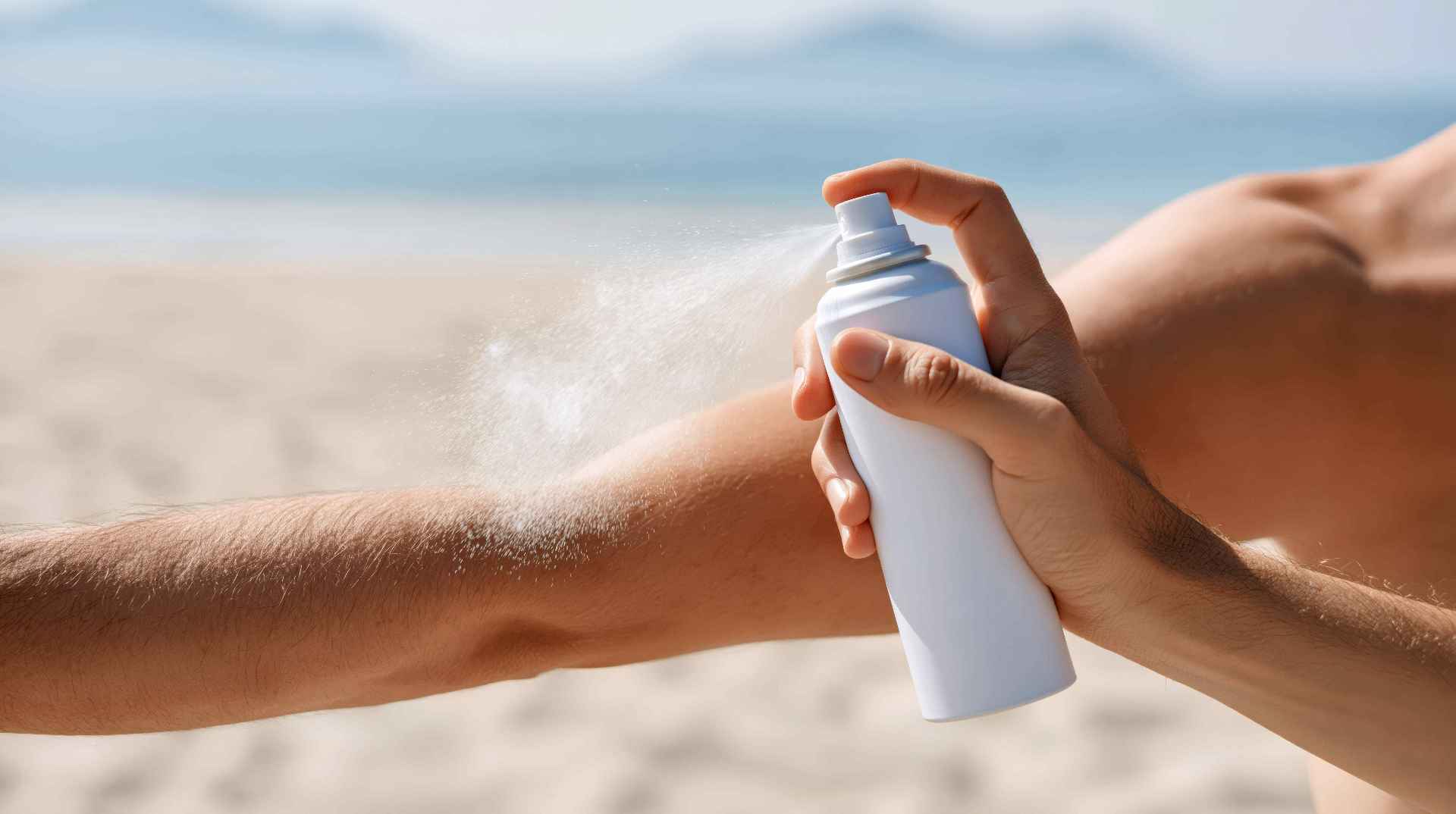
Sun protection has decoupled from the beach. As Vogue Scandinavia puts it in its 2026 face-sunscreen roundup, texture has finally caught up with necessity — today's formulas run to mist-on top-ups, featherweight gels and tinted mineral drops that double as a makeup base, worn year-round rather than seasonally. The single lotion SKU is giving way to a portfolio, each format engineered for a specific moment of use:
- Sticks — mess-free, mirror-free, reapply over makeup, target delicate zones (nose, ears, lips). One of the fastest-moving face formats — and, as O&3's formulation review details, one of the hardest to formulate: typically anhydrous, they must stay solid in the tube, melt cleanly on skin, and carry a high UV-filter load without feeling greasy.
- Tinted SPF — now mainstream. Trade reporting from Global Cosmetic Industry, citing Trendalytics, put tinted-SPF search interest up sharply year-on-year, with consumer research indicating a large majority prefer a tinted product that also protects. Tint adds visible-light/HEV defence and inclusivity across skin tones — but pigment dispersion and filter compatibility become the formulation challenge.
- Serums, setting mists and sprays — lightweight, layerable, fast-absorbing; sprays still own body coverage and reapplication convenience.
- Emerging zones — lip SPF (usually a tinted broad-spectrum balm), scalp mists and SPF powders, riding the "skinification" of hair and beauty.
Every one of these carries the same broad-spectrum, photostable requirement in a completely different delivery system. The modern brief: same protection, many vehicles.
For the formulator: the active system is half the work now. Stick structure, mist particle size, tint dispersion and texture each impose their own stability and sensory constraints.
For production: anhydrous sticks, pressurised/continuous mists and pigmented emulsions are different manufacturing lines with different fill, stability and QC profiles. Scope the line implications before the format is locked.
2. The SPF number is not the protection — and formulators know it
Peer-reviewed work has steadily dismantled the idea that a high SPF equals high protection. A position paper in Frontiers in Medicine notes that because real-world applied quantities are far below test levels, the "true" SPF on skin is much lower than the label — and that SPF, a UVB-weighted measure, says little about UVA, visible-light or oxidative protection. EWG's testing,published in Photodermatology, Photoimmunology & Photomedicine, found many US products delivered UVA protection averaging only a fraction of their labelled SPF.
The formulation consequence is a shift in what "performance" means:
- Broad, balanced protection — robust, defensible UVA alongside UVB, not just a high headline number.
- Photostability — filters degrade under UV (photodegradation); stabilised and encapsulated filter systems hold performance through the wear window.
- Non-filtering actives — the same Frontiers work highlights antioxidants and natural photoprotective compounds that defend against UV effects beyond sunburn (DNA damage, pigmentation, photoimmunosuppression), increasingly added to support — not replace — the filter system.
3. The value is in better sunscreen, not more
Headline volume growth is moderating as the category matures in developed markets — analysts including Mordor Intelligence and Fortune Business Insights describe incremental gains now tied to premiumisation rather than penetration. The margin is migrating to:
- Hybrid skincare-suncare — protection blended with hydration, anti-aging actives, peptides and antioxidants; products that justify a premium by doing more than block UV. Daily SPF is now widely positioned as a frontline anti-aging step, reinforced by dermatology guidance that daily use helps protect against up to 90% of skin aging.
- Higher SPF as default — consumers increasingly reach past SPF 30 toward 50+, raising filter load and the engineering needed to keep the product wearable.
- Cleaner and reef-conscious positioning — ingredient transparency and eco-claims have moved from differentiator to expectation, especially across European retail.
Don't optimise for cheapest-per-kilo filter. Optimise for the system — boosters, sensory modifiers, antioxidants — that lets a premium claim stand up.
For procurement: premiumisation changes the question from unit cost to formulated cost-in-use and claim support. A pricier booster that cuts total filter load can lower cost-in-use and unlock the claim that carries the margin.
4. Hybrid filter systems are the technical baseline
Underneath every format and claim sits the filter system — and single-mechanism sunscreens are being replaced by engineered combinations, as formulation guidance from UL Prospector and Covalo both set out:
- Organic + mineral, often phase-separated. A biphasic approach maximises SPF synergy and avoids known interactions — such as the yellowing when avobenzone meets titanium dioxide.
- SPF boosters that don't absorb UV but raise efficacy or photostability, letting formulators hit the target SPF at a lower filter load — better skin-feel, lower cost-in-use, easier to fit into a lightweight stick or serum.
- Beyond UV — antioxidants, pigments and HEV/blue-light deflectors for full-spectrum defence.
This is the chemistry that makes the formats (section 1), the performance (section 2) and the premium claims (section 3) actually work.
5. One formula won't ship to both markets
Here's the constraint that catches transatlantic brands: the Americas and Europe regulate UV filters differently, and a single formula rarely clears both as-is.
- Europe regulates UV filters as cosmetic ingredients and formulates with 30-plus approved filters — enabling lighter, more elegant systems and faster updates. The active European story is restriction and scrutiny (for example, homosalate under review as a potential endocrine disruptor), so reformulation risk runs toward removing or capping filters.
- The United States works with a far smaller approved set under a drug-monograph framework. Change is slow but happening — the expected mid-2026 clearance of bemotrizinol would be the first new US filter in nearly two decades, narrowing (not closing) the gap.
- Latin America is a high-growth region with its own national rules and strong demand tied to climate and outdoor lifestyle.
The practical consequence: plan filter systems per market from the start, and treat regulatory route as a formulation input — not a box ticked after the lab work.
The cross-market reality is the hidden cost in any "global" sun care launch. Design for it early, or pay for it in reformulation.
Where Safic-Alcan fits
Building a sun care range means matching filter systems, boosters and sensory modifiers to multiple formats — and to regulatory frameworks that don't agree.
Safic-Alcan supports cosmetics and personal care formulators by distributing a curated ingredient portfolio and enabling teams through application-laboratory expertise across different regions: dedicated Cosmetics labs in France, Italy, the United Kingdom and Türkiye across EMEA, and in Brazil and Peru across the Americas — backed by recent regional expansions in India and Malaysia.
Explore our sun care and personal care portfolio
Browse our sun care portfolio and find the ingredients that best fit your use case!
Frequently asked questions
What are the biggest sun care trends in 2026?
The shift of sunscreen into a daily beauty/skincare product across new formats (sticks, tinted SPF, serums, mists, lip and scalp SPF); a move beyond the SPF number toward broad-spectrum, photostable, real-world protection; premiumisation toward multi-benefit hybrids and higher SPF; hybrid organic-plus-mineral filter systems with SPF boosters; and the growing complexity of formulating for the different regulatory frameworks of Europe, the US and Latin America.
Why do new sunscreen formats like sticks and tinted SPF matter?
Research shows most people apply only 25–50% of the recommended amount of sunscreen and rarely reapply (the American Academy of Dermatology, and consumer data from FEBEA and Statista). Formats that are easy to apply over makeup, on the go and to often-missed zones (lips, ears, scalp) are designed to close that real-world protection gap — which is why they're reshaping the category.
Does a higher SPF mean better protection?
Not necessarily. SPF is a UVB-weighted measure and says little about UVA, visible-light or oxidative protection; peer-reviewed work (e.g. Frontiers in Medicine; EWG testing in Photodermatology, Photoimmunology & Photomedicine) shows real-world protection is often well below the label because of under-application. Broad-spectrum coverage, photostability and correct application matter more than the headline number.
What is a hybrid sunscreen system?
A hybrid system combines organic (chemical) and mineral (physical) UV filters — often in separate phases and may add SPF boosters, antioxidants and HEV/blue-light deflectors. The goal is broader, more stable protection with better skin-feel and a lower total filter load.
What is an SPF booster and why does it matter?
An SPF booster is an additive that doesn't absorb UV itself but increases the efficacy or photostability of the filter system. Boosters let formulators hit a target SPF with less active filter — improving sensory profile, lowering cost-in-use, and making it easier to fit protection into lightweight formats like sticks and serums.
Why can't the same sunscreen be sold in both Europe and the US?
Europe regulates UV filters as cosmetic ingredients and permits 30-plus filters, while the US uses a drug-monograph framework with a much smaller approved set; Latin American markets add their own national rules. A formula approved in one region often must be re-engineered for another, so filter selection should be planned per market from the outset.
Is sun care still a seasonal market?
No. Sun protection has decoupled from summer and is now positioned as daily-use skincare — embedded in serums, tinted moisturisers, makeup and everyday routines — driving year-round demand and raising the bar on texture, finish and wearability.
Where can I source sun care and UV filter ingredients for the Americas and Europe?
Safic-Alcan distributes a curated personal care and sun care ingredient portfolio, supported by Cosmetics & Fragrances application laboratories in France, Italy, the UK, Türkiye, Brazil and Peru. Explore the catalog or speak to a specialist to match filter systems, boosters and formats to your target markets and claims.