


Silica reinforces, but it does not bond to rubber on its own. The coupling silane does that job, and the one you pick decides how the compound mixes, when it scorches, how much ethanol leaves the mixer and what the cured part does on the road. This guide compares the main families and gives the trade-offs behind each choice.
Quick answer
- TESPT (Si 69 type) is the reference: proven, robust, and its sulfur takes part in the cure, which shortens scorch time as the dosage rises.
- TESPD (disulfide, Si 266 type) is more temperature stable during silanisation, which helps when mixing hot.
- Unblocked mercaptosilanes couple very efficiently at low dosage, but react too readily: high viscosity, premature curing and odour.
- Blocked mercaptosilanes were developed to keep the efficiency and delay the reaction.
- Ethanol release is a real process constraint, not a detail: triethoxysilanes can release up to three moles of ethanol per silane equivalent.
What the silane actually does
Two reactions happen during mixing: the silane bonds to the silica surface, and the silane reacts with the rubber. Ethanol is generated as a by-product of that silanisation. The practical consequence is that mixing temperature, cycle and addition sequence matter as much as the silane itself: good processing is always a compromise between temperature, mixing cycles and time, and the right choice and addition points of the ingredients (Rubber & Plastics News technical review).
The families compared
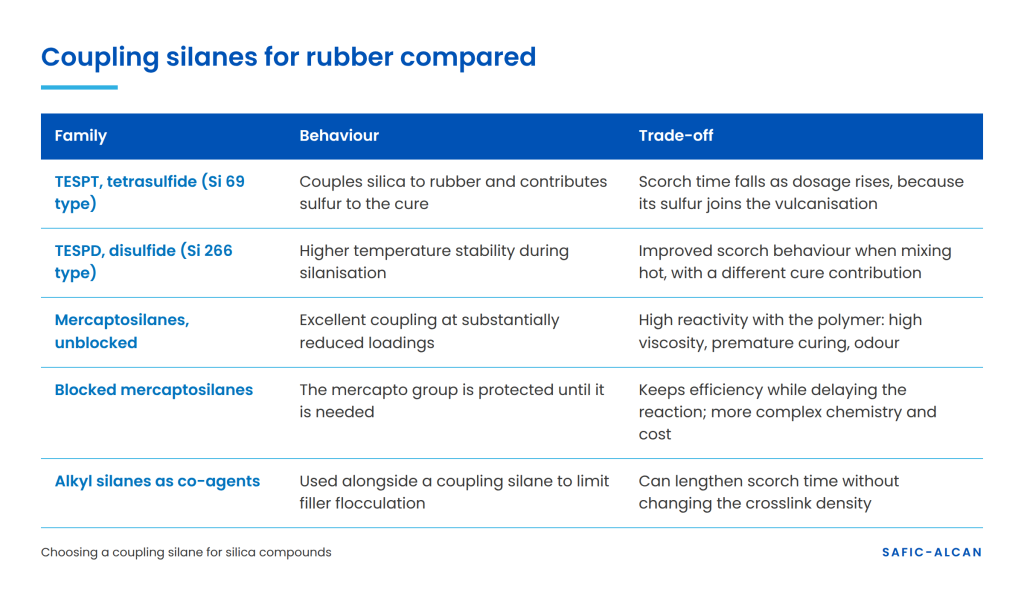
The reactivity problem with unblocked mercaptosilanes is well documented: their high chemical reactivity with organic polymers leads to unacceptably high viscosities during processing and to premature curing, which makes compounding and processing more difficult (USPTO). Blocking the mercapto group was developed precisely to keep the coupling performance while avoiding that premature reaction (USPTO).
On the disulfide side, TESPD has higher temperature stability than TESPT and therefore improved scorch behaviour during silanisation at high mixing temperatures (Silanization characterization study). And in a comparison of loadings, Mooney scorch time decreased as the mercaptosilane level rose, while it increased with Si 69 (ResearchGate summary).
Not sure which silane suits your mixing cycle?
Tell us the filler, the polymer and your mixing temperatures. Safic-Alcan will suggest the grades available in your country and arrange samples.
Ethanol: the constraint people forget
Traditional coupling silanes carry three ethoxy groups on each silicon atom, which can release up to three moles of ethanol for each silane equivalent during manufacture. Ethanol is flammable, which creates a fire risk, and it contributes to volatile organic compound emissions (USPTO). That is why newer chemistries aim to cap the ethanol released, and why extraction and mixing practice matter when you increase silane dosage.
Choosing in practice
- Start from the mixing temperature. If you mix hot and struggle with scorch, temperature stability during silanisation is your first criterion.
- Then look at the cure system. A polysulfide silane contributes sulfur; a mercaptosilane does not in the same way. Changing family usually means re-balancing the cure package.
- Check dosage against effect, not price. Mercapto chemistries couple at lower loadings, which changes the cost comparison.
- Plan for ethanol. Extraction, mixing cycle and, in some cases, a different silane chemistry.
- Requalify properly. A silane change affects processing, cure and dynamic properties at once, so it needs a full compound requalification, not a drop-in trial.
What we distribute
Safic-Alcan distributes Si 69 and Si 266 from Evonik for rubber compounding, alongside precipitated silica grades. For the wider silane picture beyond rubber, see our guide to organosilanes. On the filler side, our articles on precipitated silica and fumed silica cover grade selection, and our guide to crosslinking agents covers the cure side of the compound.
Reformulating a silica compound?
Our rubber specialists can compare silane options with you and provide samples of the grades available in your market.
Frequently asked questions
What does a coupling silane do in a rubber compound?
It bonds the silica surface to the polymer. During mixing, the silane reacts with the silica and with the rubber, and ethanol is released as a by-product of the silanisation.
Why does my compound scorch when I increase the silane?
With a tetrasulfide silane, the sulfur takes part in the vulcanisation, so a higher dosage shortens the scorch time. With mercaptosilanes, the mercapto group itself reacts readily with the polymer.
What is a blocked mercaptosilane?
A mercaptosilane whose reactive group is chemically protected so that it stays in a state of reduced activity until it is needed, which limits premature curing while keeping the coupling efficiency.
Is TESPD better than TESPT?
Not better, different. TESPD has higher temperature stability during silanisation and improved scorch behaviour at high mixing temperatures, with a different contribution to the cure.
Can I swap one silane for another without changing anything else?
No. A silane change affects processing, cure and dynamic properties together, so the cure package usually needs re-balancing and the compound needs full requalification.