


Hydroxypropyl methylcellulose (HPMC) and hydroxypropyl cellulose (HPC) are two of the most widely used cellulose ethers in solid dosage form manufacturing. Both are semi-synthetic polymers derived from natural cellulose, both are listed in the major pharmacopeias, and both appear in hundreds of approved oral drug products worldwide. Yet they are not interchangeable. Their substitution chemistry, solubility profiles, viscosity ranges, and processing behaviours differ in ways that matter when selecting an excipient for a specific formulation strategy.
This article covers the properties and pharmaceutical functions of each polymer, the criteria that guide grade selection, and the practical differences between the two when working on tablets and capsules.
Quick answer
HPMC (also known as hypromellose) is a dual-substituted cellulose ether carrying both methyl and hydroxypropyl groups. It is soluble in cold water but insoluble in most organic solvents. Depending on the viscosity grade selected, it acts as a wet granulation binder, a film-coating polymer, or a rate-controlling matrix former in extended-release tablets.
HPC is substituted with hydroxypropyl groups only. Unlike HPMC, it dissolves in both cold water and polar organic solvents such as ethanol and isopropanol, and it exhibits thermoplastic behaviour above approximately 130°C. Its primary pharmaceutical uses are as a wet granulation binder, a dry binder for roller compaction, and a film-forming agent in solvent-based coating systems.
The two polymers serve overlapping but distinct formulation roles. Choosing between them depends on the manufacturing process, the release profile required, and the physicochemical properties of the active pharmaceutical ingredient.
Contact a Pharmaceuticals expert
Get in touch with one of our technical experts today
Common origin, different chemistry
Both HPMC and HPC are produced by etherification of alkali-activated cellulose. Cellulose itself is a linear polysaccharide of D-glucopyranose units linked by 1,4-β-glycosidic bonds. Its hydroxyl groups are poorly reactive in their native state, but treating cellulose with sodium hydroxide activates them. Subsequent reaction with chloromethane and propylene oxide yields HPMC; reaction with propylene oxide alone yields HPC.
The practical consequence is chemical: HPMC carries both methoxy (hydrophobic) and hydroxypropoxy (hydrophilic) substituents on each anhydroglucose unit, whereas HPC carries hydroxypropoxy substituents only. This difference in substitution drives most of the functional divergence between the two polymers.
HPMC: substitution types, grade nomenclature, and viscosity
HPMC grades are defined by two parameters: the substitution type and the viscosity of a 2% w/w aqueous solution at 20°C.
Substitution types. The four-digit code assigned to HPMC by the pharmacopeias describes the approximate percentage of methoxy and hydroxypropoxy groups. The three commercially relevant pharmaceutical types are:
- 2910 (known as "E" chemistry): 28–30% methoxy, 7–12% hydroxypropoxy, gel temperature 58–64°C
- 2208 (known as "K" chemistry): 19–24% methoxy, 4–12% hydroxypropoxy, gel temperature 70–90°C
- 2906 (known as "F" chemistry): 27–30% methoxy, 4–7.5% hydroxypropoxy, gel temperature 62–68°C
The K chemistry (HPMC 2208) is the type most frequently used in hydrophilic matrix tablets, partly because its higher gel temperature provides a more robust gel layer at physiological temperature.
Viscosity grades. HPMC viscosity grades range from 3 to 100,000 mPa·s, measured on a 2% aqueous solution. The most common low-viscosity (LV) grades are E3 LV, E5 LV, E6 LV, E15 LV, and E50 LV. High-viscosity grades include K4M, K15M, K100M, and K200M. The number in each designation reflects the nominal viscosity in mPa·s.
This range has direct formulation consequences. Low-viscosity grades (below 50 mPa·s) are used where a binder or film former is needed without significantly raising solution viscosity. High-viscosity grades are used to build the gel layer that controls drug diffusion and erosion in matrix tablets. In matrix tablets, higher polymerization degree implies higher viscosity and, at equivalent polymer concentration, a thicker and more mechanically resistant gel layer.
Pharmaceutical functions of HPMC in solid dosage forms
Binder in wet granulation
Low to medium viscosity grades (E5 LV, E15 LV, K4M) are used as binders in wet granulation, typically at 2–5% w/w in the granulating liquid. HPMC produces granules with good flowability and compressibility. Its non-ionic nature means it is compatible with a wide pH range and does not interact ionically with most APIs or co-excipients.
Film coating
Low-viscosity HPMC grades, particularly E5 LV and E15 LV, are the standard aqueous film-coating polymers for immediate-release tablets. They form clear, flexible films that mask taste, improve swallowability, protect against moisture, and allow colorant incorporation. HPMC is insoluble in ethanol, so it is processed from aqueous dispersions. Coating systems based on HPMC are well established in regulatory submissions globally.
Extended-release matrix
High-viscosity K grades (K15M, K100M, K200M) are the primary excipients for hydrophilic matrix extended-release tablets. When the tablet contacts gastrointestinal fluid, water penetrates the matrix, the HPMC hydrates, and a viscous gel layer forms at the tablet surface. Drug release then proceeds through a combination of diffusion through the gel and surface erosion. The rate of release is controlled by the viscosity grade selected, the polymer concentration in the formulation, and the tablet geometry. This mechanism and grade selection for K200M is detailed in a dedicated article on this site.
HPC: properties and formulation roles
HPC (CAS 9004-64-2) is a non-ionic, water-soluble cellulose ether with a higher degree of hydroxypropyl substitution than HPMC. Its molar substitution is typically between 3 and 4 hydroxypropyl groups per anhydroglucose unit.
Two properties distinguish HPC from HPMC and make it a different tool.
Solubility in organic solvents. Unlike HPMC, HPC is soluble in ethanol and isopropanol in addition to cold water, making it suitable for solvent-based coating processes.
Thermoplastic behaviour. HPC has a glass transition temperature around 130°C and a melting point in the 115–145°C range depending on grade and molecular weight. This thermoplastic character means HPC can be processed by hot-melt extrusion (HME), a solvent-free technology increasingly used for amorphous solid dispersions of poorly water-soluble drugs. HPMC, by contrast, does not behave as a thermoplastic under standard pharmaceutical processing conditions.
Grades
HPC is available across a range of molecular weights that govern viscosity and processing behaviour. Standard pharmaceutical grades (H-HPC) include, from low to high molecular weight: EXF (~80 kDa), EF (~140 kDa), LF (~370 kDa), MF (~850 kDa), and GF (~1250 kDa). HPC tablet formation is characterised by high plastic deformation, with elastic recovery and compactibility profiles that differ markedly from microcrystalline cellulose and spray-dried lactose.
A separate category, low-substitution HPC (L-HPC), has a much lower degree of hydroxypropyl substitution and is insoluble in water. L-HPC is used primarily as a disintegrant in tablet formulations and is outside the scope of this article.
Binder in wet granulation and roller compaction
EXF and EF grades are the most commonly used HPC binders. In wet granulation, HPC is typically incorporated at 2–6% w/w. It can be granulated from aqueous solution or from ethanolic solution, giving formulators flexibility with moisture-sensitive compounds.
Fine-particle HPC has been evaluated as a dry binder for roller compaction. Roller compaction studies using acetaminophen formulations incorporating 4–8% w/w fine-particle HPC showed friability below 1% across all compression forces tested, with tablet hardness meeting standard thresholds. HPC's high plastic deformation under compaction pressure contributes to this performance.
Film coating from organic solvent systems
HPC forms flexible, transparent films from ethanolic solution. Its use as a film former is particularly relevant when the coating process requires a solvent-based system, for example to achieve rapid film formation on hygroscopic cores or when aqueous coating conditions would cause unacceptable tablet weight gain or API degradation.
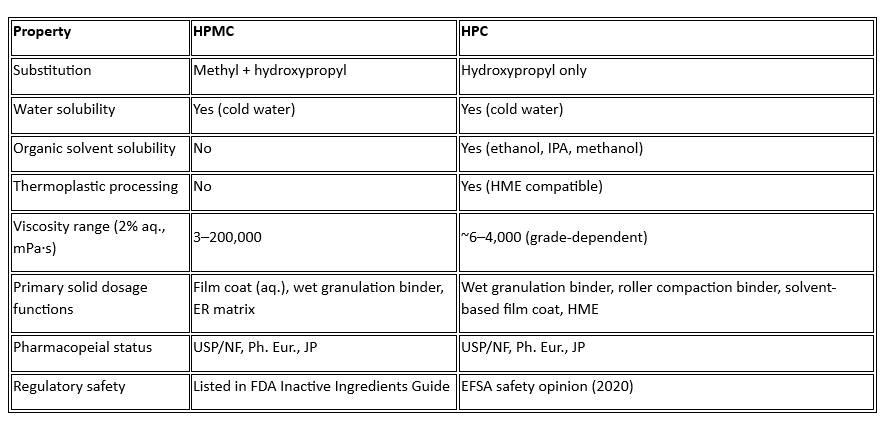
HPMC vs HPC: a comparison
Selecting the right grade: a process-based approach
The starting point for grade selection is not the polymer properties but the manufacturing process and the target release profile.
- Immediate-release tablets, wet granulation route. HPMC E5 LV or E15 LV at 2–5% w/w is the standard choice. HPC EXF or EF is an alternative when organic solvent granulation is needed or when the formulator prefers the plastic deformation characteristics of HPC for compaction.
- Immediate-release tablets, direct compression route. HPC EXF in fine-particle form provides dry binding functionality with acceptable flow. HPMC performs less well as a dry binder in conventional grades; DC-grade HPMC formulations are available but represent a different product category from standard HPMC.
- Immediate-release tablets, roller compaction. Fine-particle HPC is the clearer choice between the two polymers. Its plastic deformation under compaction pressure translates into adequate ribbon quality and granule compressibility.
- Aqueous film coating, immediate release. HPMC E5 LV or E15 LV, optionally with a plasticizer. This is the most established regulatory pathway for aqueous film coating globally.
- Solvent-based film coating. HPC, particularly LF or MF grades in ethanolic solution.
- Extended-release matrix tablets. HPMC K grades (K15M, K100M, K200M) depending on the required release rate. HPC is not typically used for hydrophilic matrix extended-release because its gel-forming capacity at physiological temperature is less predictable than that of high-viscosity HPMC.
- Hot-melt extrusion. HPC is processable by HME. HPMC is generally not, due to its higher processing temperature requirements relative to thermal degradation onset.
Regulatory status
Both HPMC and HPC are monographed in the United States Pharmacopeia/National Formulary (USP/NF), the European Pharmacopoeia (Ph. Eur.), and the Japanese Pharmacopoeia (JP). Both appear in the FDA Inactive Ingredients Database for oral solid dosage forms. The safety of HPC has been evaluated by the EFSA FEEDAP Panel, which concluded it is safe for all animal species and poses no concern for consumer safety.
HPMC and HPC are both non-ionic, which means they are stable across a broad pH range (approximately 3–11 for HPMC) and do not form ionic complexes with the majority of APIs. Compatibility with the specific active ingredient should still be confirmed analytically, using DSC, FT-IR, or XRPD, as recommended analytically in peer-reviewed formulation literature.
Frequently asked questions
Is HPMC the same as hypromellose?
Yes. Hypromellose is the International Nonproprietary Name (INN) for hydroxypropyl methylcellulose. The two terms refer to the same substance; hypromellose is used in pharmacopeial monographs and regulatory submissions, while HPMC is more common in technical and commercial contexts.
What is the difference between HPMC and HPC?
HPMC carries both methyl and hydroxypropyl substituents on the cellulose backbone; HPC carries hydroxypropyl groups only. This results in different solubility profiles (HPMC is insoluble in organic solvents, HPC is not), different processing windows (HPC is thermoplastic, HPMC is not), and different primary formulation roles.
What does HPMC do in a tablet
Depending on the grade selected, HPMC acts as a binder that holds granules together, a film-coating polymer that protects the tablet surface, or a rate-controlling matrix former that slows drug release. Low-viscosity grades serve the first two functions; high-viscosity K grades serve the third.
Can HPC be used for extended-release formulations?
HPC is not typically used as the primary matrix-forming polymer for hydrophilic extended-release tablets. Its gel-forming characteristics at physiological temperatures are less consistent than those of high-viscosity HPMC K grades. HPC may appear in combination ER formulations or in HME-based amorphous solid dispersion systems where controlled release is achieved by a different mechanism.
Are HPMC and HPC compatible with each other in the same formulation?
Generally yes. Both are non-ionic cellulose ethers with no reported electrostatic incompatibility between them. They have been used in combination in coating systems and granulation binders. Compatibility with the API and other excipients remains formulation-specific and should be verified.