


In June 2026 we have asked formulators attending one of our webinars this exact same question.The majority of them have answered, and picked the same option: that a preservative-free claim means the product is preserved with an ingredient outside Annex V.
That answer is everywhere in the industry. It is also only half the test, and the missing half is where brands get caught.
Start with what the law does not say. Regulation (EC) No 1223/2009 never defines "preservative-free". It does not ban the term. It does not oblige you to use an Annex V preservative at all. Article 10 asks for something different: a documented safety assessment showing the product is safe under normal and reasonably foreseeable use. Annex V is a positive list of what is permitted, with conditions attached to each of its roughly sixty entries. It is not a shopping list you are required to buy from.
The constraint on the wording sits elsewhere. Article 20 prohibits misleading information. Commission Regulation (EU) No 655/2013 then sets six common criteria that every claim must satisfy: legal compliance, truthfulness, evidential support, honesty, fairness, and informed decision-making. The Commission's Technical Document on Cosmetic Claims interprets how those six apply to "free from" wording specifically. Its Annex III has applied across Member States since 1 July 2019.
So the question a formulator should ask is not is my multifunctional listed in Annex V. It is what is that multifunctional actually doing in my formula.
Why a preservative-free claim is not an Annex V question?
A substance added to a cosmetic in order to inhibit microbial growth is regulated as a preservative and has to be assessed as one. That is the logic of the list, and you can check any individual entry in the Commission's CosIng database.
Plenty of substances with real antimicrobial activity sit outside it. Caprylyl glycol, 1,2-hexanediol, glyceryl caprylate, ethylhexylglycerin, levulinic acid, anisic acid, ethanol. Each has a legitimate primary function, emollient, humectant, solvent, deodorising agent, pH adjuster, and using them on that basis is entirely lawful. Nobody is suggesting otherwise.
The wording is a separate matter. Under the truthfulness and honesty criteria, a claim is assessed on how the average end user will read it. A consumer reading "preservative-free" understands nothing in here stops bacteria growing. If your formula depends on a multifunctional system to pass its challenge test, that reading is wrong, and the gap between the two is the enforcement exposure. Two brands can use the identical multifunctional at the identical level, and only one of them is leaning on it for microbiological protection. The INCI list cannot tell them apart. Your challenge test data can.
There is a second problem that gets less attention. Annex III of the Technical Document also addresses claims that denigrate lawfully permitted ingredients. This is why regulators cooled on "paraben-free": methylparaben and ethylparaben are permitted at up to 0.4% each and have been repeatedly reaffirmed as safe in SCCS opinions, so a claim built on their absence disparages an authorised group. The same reasoning is available to an authority looking at a blanket preservative-free flash on a carton.
Three preservative-free positions that hold up
Describe the system instead of the absence. "Preserved with a multifunctional system" and "formulated without Annex V preservatives" are both truthful, both survive the six criteria, and neither denigrates anything. They are duller. They are also not withdrawable.
Earn a genuine low-risk classification. ISO 29621:2017 sets out how to determine that a product presents a low microbiological risk. The usual anchors are water activity below 0.75, where most organisms cannot grow, and below 0.60, where essentially none can; ethanol above roughly 20%; and pH at or below 3 or at or above 10. Anhydrous balms, powders, solid perfumes and high-alcohol systems can genuinely fall here. Where you can document it, the position is a physicochemical property rather than a marketing line. The safety assessor still signs it off, and many will still ask for testing in borderline cases between 0.60 and 0.75 aw.
Generate the data, then write the wording. EN ISO 11930:2019+A1:2022 inoculates five standard organisms (S. aureus, E. coli, P. aeruginosa, C. albicans, A. brasiliensis) and measures log reduction at days 7, 14 and 28 against two acceptance criteria, not four. Criterion A is the target. Criterion B is the lower bar, and the standard accepts it only where you can additionally justify that the product is sufficiently protected, typically through packaging or conditions of use. It is not a rinse-off allowance. Without that data, or a documented ISO 29621 exemption, a product carrying no Annex V preservative has an incomplete Article 10 safety assessment. A short shelf life does not substitute for it.
The routes compared, with their claim exposure
Concentration limits below are the current Annex V maxima. Verify any entry against CosIng before it goes into a CPSR, since entries move.
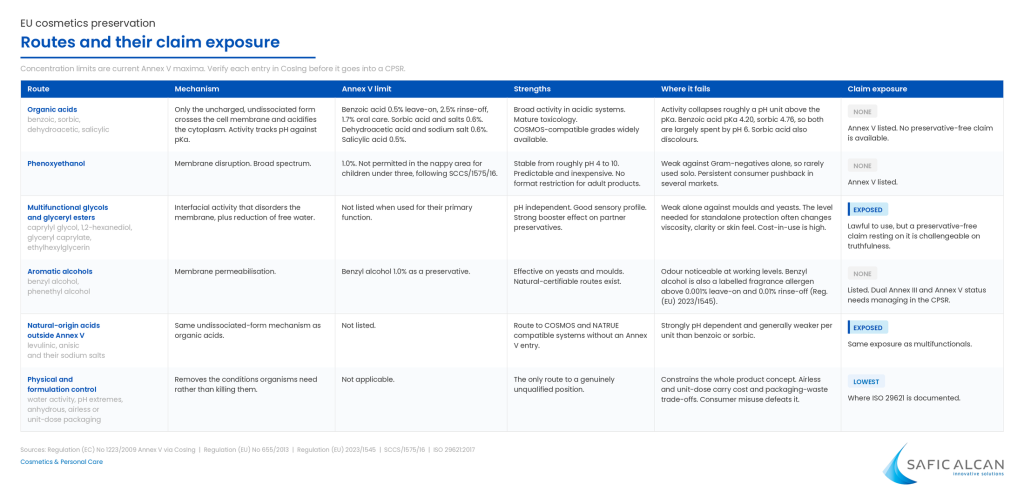
Only two of the six routes leave a preservative-free claim exposed. Limits are current Annex V maxima; verify in CosIng before use in a CPSR.For the full Annex V picture, including parabens, formaldehyde releasers and the 2026 amendments, see our EU regulatory guide to preservatives in cosmetics.
Where this framework falls short
Two weaknesses, and both matter more than the neat structure above suggests.
The Technical Document on Cosmetic Claims is guidance, not law. It was agreed by a sub-working group, it says so itself, and only the Court of Justice can give an authoritative interpretation. National authorities have signalled they will apply it and several do, but not uniformly. The practical consequence is uncomfortable: you can sell a preservative-free product in one Member State without incident and be challenged in another with identical packaging and an identical formula. No formulator can engineer that away. It is a commercial risk call, and it belongs to regulatory affairs and the brand owner rather than to the bench.
The second weakness is in the chemistry. pKa reasoning tells you reliably when an organic acid cannot work. It tells you very little about whether it will. A benzoic acid system at pH 4.5 sits comfortably inside its theoretical window and can still fail, because the acid partitions into the oil phase, or gets sequestered into non-ionic surfactant micelles, or the botanical extract load is feeding the organisms faster than the acid suppresses them, or water activity is higher than anyone measured. None of that appears in a pKa calculation. The theory takes a shortlist of twenty candidates down to four. It does not replace the challenge test, and any article that implies it does, including this one if you read it that way, is doing you a disservice.
What to test first
The order matters more than the choices, because it eliminates most candidates before you spend a day on microbiology.
- Set pH before you set the preservation system. If the formula has to sit above pH 5.5, organic acids are out as the primary route. Establish that first rather than proving it over three weeks.
- Check ISO 29621 before assuming you need protection at all. A meaningful share of briefs described as preservative-free are simply low-risk products that never needed the argument in the first place. Measure water activity early.
- Screen two or three systems, and keep an Annex V control. Include it even when the brief forbids it. If the preferred system fails and the control passes, the problem is the preservation system. If both fail, the problem is the formula.
- Run the challenge test on the final formula in the final pack. Packaging changes the outcome, particularly for anything airless or unit-dose. Testing a bulk sample and shipping a different closure is a common and expensive mistake.
- Write the claim last. Decide the wording with the challenge test report in front of you, never in the brief. Reversing that order is the single most frequent cause of launch delay in this area.
The deeper technical background on growth conditions and hurdle strategy sits in our article on microbiology and preservation in cosmetics, and the 2026 Annex V amendments are covered in what's changing in Annex V.
Safic-Alcan distributes preservation and multifunctional ranges spanning organic acids and their salts, phenoxyethanol systems, multifunctional glycols and glyceryl esters, aromatic alcohols, and natural-origin acid systems compatible with COSMOS and NATRUE, alongside the emollients, solubilisers and rheology modifiers that determine how any of them behave in a real formula. Our cosmetics application specialists work this trade-off daily. Bring us a brief before you commit to a pH