


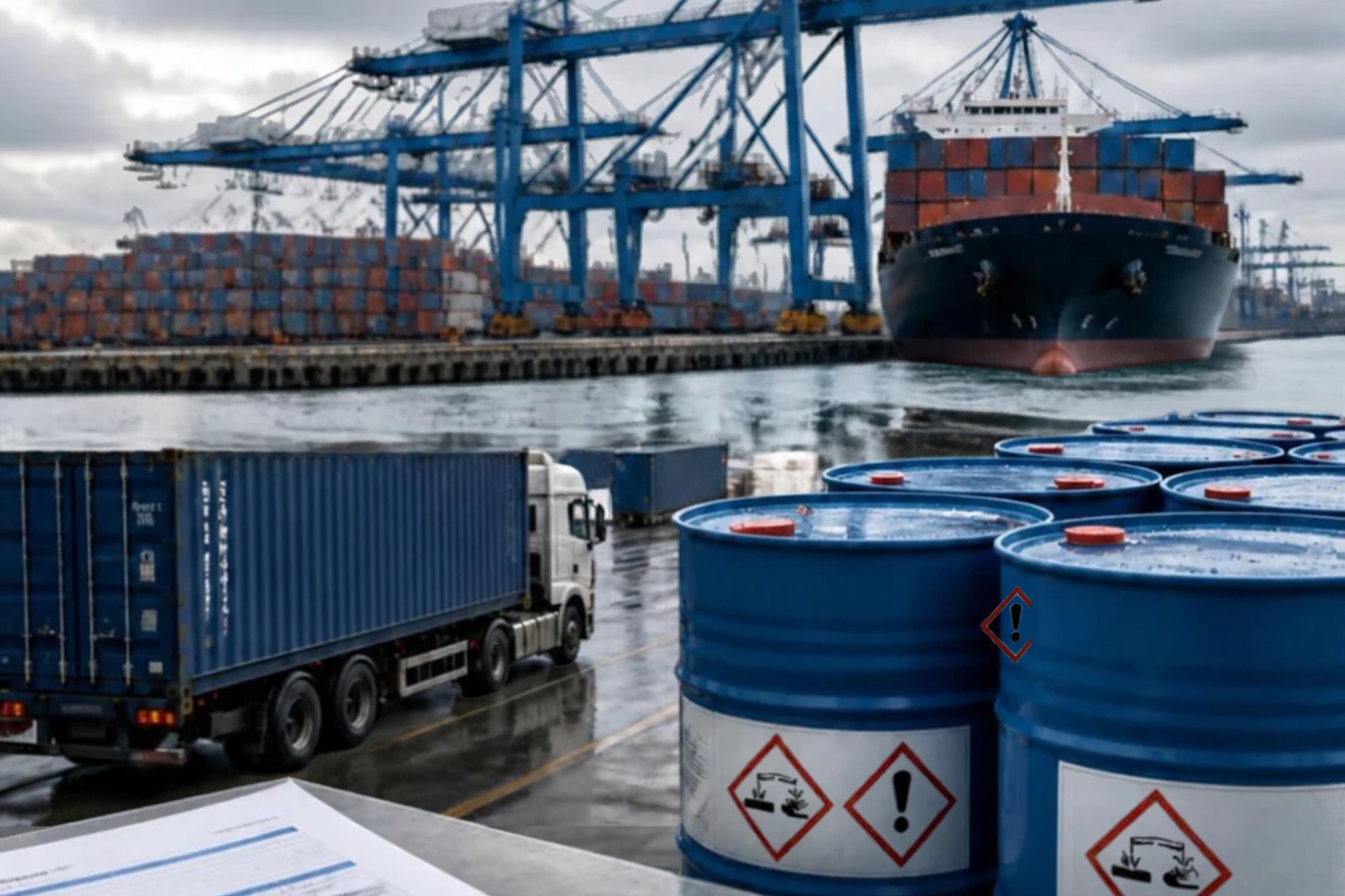
Buying directly from a producer outside Europe often looks like the cheaper route. It can be, as long as you know what comes with it. The moment a substance crosses into the EU, someone becomes the importer, and with that role comes registration, classification and notification duties. This article sets out who carries what, when an only representative changes the picture, and what to check before the first shipment.
Quick answer
- Companies outside the EU or EEA have no direct REACH obligations. The EU importer carries them.
- Registration applies at one tonne per year or more, per substance, including substances inside imported mixtures.
- The tonnage is cumulative: the same substance arriving in several different mixtures counts once, added up.
- A non-EU manufacturer can appoint an only representative, which removes the registration duty from the importer, who then acts as a downstream user.
- Some duties, such as supply chain communication and restrictions, apply whatever the tonnage.
Who is the importer?
Any company sourcing substances, mixtures or articles from outside the EU and EEA is an importer and is responsible for REACH and CLP compliance (Health and Safety Authority, Ireland). Companies established outside the EU or EEA do not have obligations under REACH themselves: it is the EU importer sourcing from them who must comply (European Commission, Your Europe).
Two practical consequences. Buying from an EU distributor generally means you are not the importer for that material. Buying directly from a producer in Asia or the United States generally means you are, even when a freight forwarder handles the paperwork.
What the importer has to do
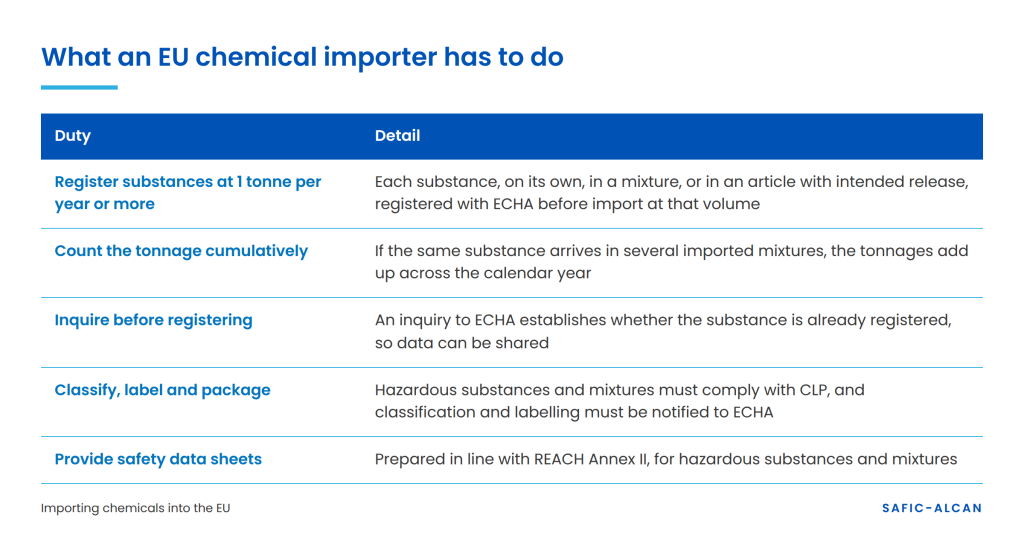
Sources: HSA chemical importers information sheet and ECHA guidance on safety data sheets. One point catches people out: for mixtures, the tonnage of each substance is calculated from the composition in section 3.2 of the safety data sheet, and where only a concentration range is given, the upper limit is used (HSA).
Thinking of importing directly?
Safic-Alcan can tell you whether the grade you are looking at is already available in your market, and what that changes for your obligations.
The only representative, and what it changes
A non-EU manufacturer cannot register a substance itself, but it can appoint an only representative established in the EU. The only representative completes the registration on behalf of the EU importers, which removes that duty from them (HSA). The importer then acts as a downstream user for that substance (Your Europe).
Three checks are worth making in writing before the first order:
- Does an only representative exist for this substance and this manufacturer, and is it established in the EU?
- Is your tonnage covered by that registration? Coverage is per importer and per volume, not automatic.
- Do you have written confirmation? A verbal assurance is not evidence during an inspection.
What does not depend on tonnage
The one tonne threshold applies to registration only. Restrictions, authorisation and supply chain communication, including safety data sheets, apply whatever the volume (Your Europe). A 200 kg import of a restricted substance is still a restricted substance.
Two other regimes travel with imports and are often forgotten: classification and labelling notification to ECHA, which applies irrespective of tonnage for hazardous substances placed on the market (HSA), and the newer supply chain rules such as the deforestation regulation. Our EUDR scope guide covers which raw materials are caught and from when.
Import directly, or buy in Europe?
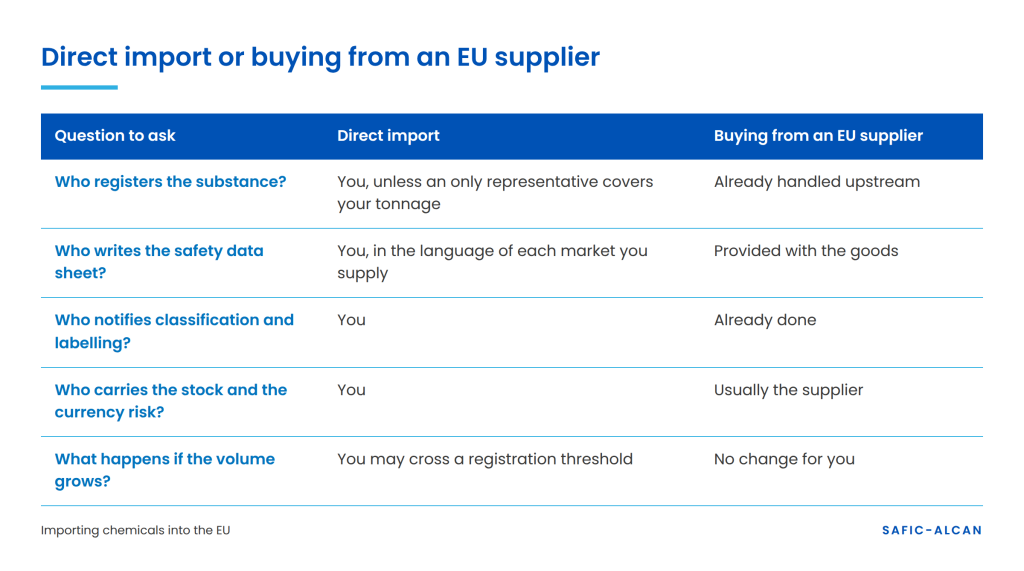
There is no universal answer: direct import can make sense at volume and with the right internal resources. What is not advisable is discovering the obligations after the container has left. Our article on what a distributor can and cannot do on your regulatory behalf sets out where a distributor helps, and our guide to sourcing specialty chemicals in Europe covers the wider supply picture. For substances under pressure from restrictions, see our REACH 2026 update.
Comparing a direct import with a European supply?
Send us the substance and the volume. We will tell you what we can supply locally and what it would change for your compliance workload.
Frequently asked questions
Who has to register a substance imported into the EU?
The EU importer, for each substance imported at one tonne per year or more, whether on its own, in a mixture, or in an article with intended release, unless an only representative covers that tonnage.
Do I register a mixture?
No. Registration applies to the substances in the mixture, each counted at its own tonnage, calculated from the composition in section 3.2 of the safety data sheet.
Does the tonnage reset for each product?
No. The tonnage of a substance is cumulative across all the products you import in a calendar year.
What is an only representative?
An entity established in the EU, appointed by a non-EU manufacturer, that takes on the importer registration obligations. The importer then acts as a downstream user for that substance.
We import less than one tonne. Are we exempt from REACH?
From registration, yes. Not from restrictions, authorisation requirements, classification and labelling duties or supply chain communication.