


The EU Deforestation Regulation (EUDR) applies from 30 December 2026, and most of the attention has gone to coffee, cocoa and timber. Chemical buyers have a less obvious question: which of the raw materials we buy every month are caught? Palm-based oleochemicals, natural rubber, cocoa butter and soy derivatives can all fall within the EUDR scope, but not automatically, and not all on the same date. This guide explains the test that decides it and what changed in 2026.
Quick answer
- The EUDR covers seven commodities (cattle, cocoa, coffee, oil palm, rubber, soy and wood) and the derived products listed in its Annex I.
- A chemical raw material is in scope when its customs (CN) code is listed in Annex I and it was actually made using one of those commodities. Containing a trace of palm is not the test.
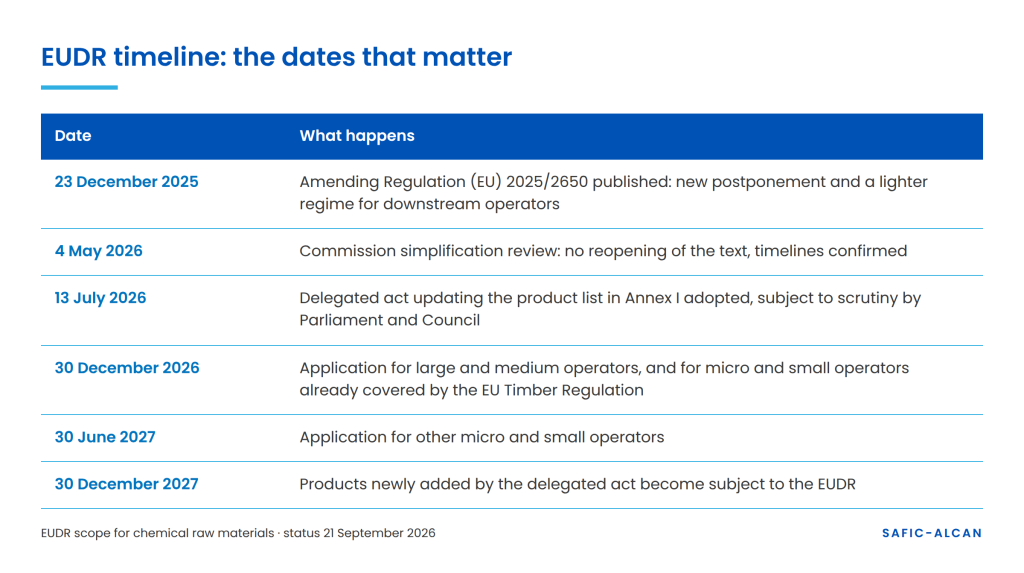
- Application: 30 December 2026 for large and medium operators, 30 June 2027 for most micro and small operators.
- A delegated act adopted on 13 July 2026 adds more palm oleochemicals, such as fatty alcohols, crude glycerol and certain fatty acid esters, from 30 December 2027.
Status checked on 21 September 2026. The EUDR has been amended several times; check the Official Journal before making compliance decisions.
What the EUDR is, and when it applies
Regulation (EU) 2023/1115 requires that relevant products placed on the EU market or exported from it are deforestation-free, legally produced and covered by a due diligence statement. It was postponed twice. The latest amendment, Regulation (EU) 2025/2650, was published on 23 December 2025 and introduced a new category of downstream operators (Stibbe). In May 2026 the Commission published its simplification review and confirmed that the text will not be reopened and the timelines stand (Baker McKenzie).
The test: is your raw material in the EUDR scope?
The deciding factor is not whether a product contains palm, rubber or soy. It is whether the product falls under a customs code listed in Annex I (Coolset). The July 2026 delegated act also inserts "ex" before various oil palm and rubber entries, which confirms that a listed code is covered only where the product was actually made using the commodity: tyres made with natural rubber are covered, tyres made with synthetic rubber are not (Covington).
- Find the CN code of the product as it is imported, placed on the EU market or exported. Your customs broker or supplier can confirm it.
- Check Annex I of Regulation (EU) 2023/1115 for that code, including the entries added by the July 2026 delegated act.
- Check the "ex" condition: was the product made using one of the seven commodities? A synthetic or non-palm grade under the same code is outside scope.
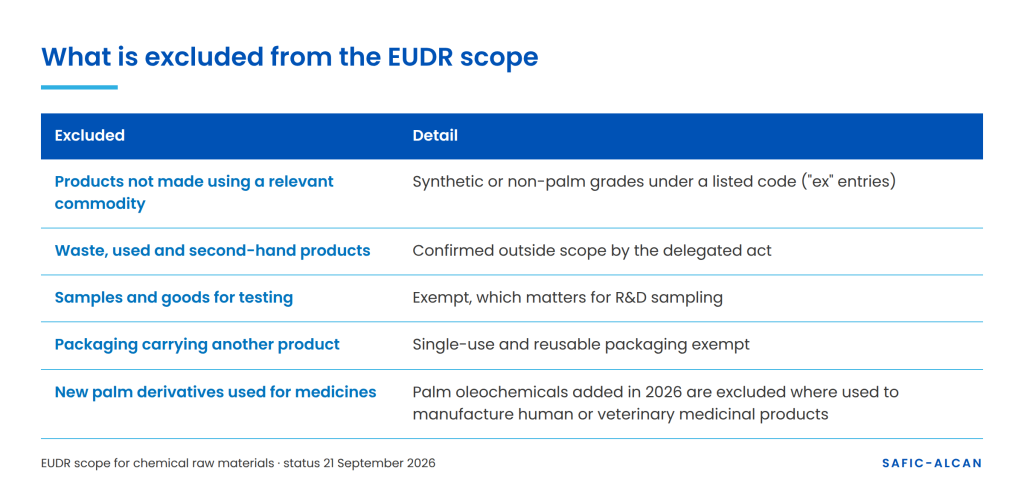
- Check the exclusions (see below): waste, samples, packaging and, for the new palm derivatives, use in medicinal products.
- Check the date: products already listed apply from 30 December 2026; products added in July 2026 apply from 30 December 2027.
Which chemical raw materials can be affected
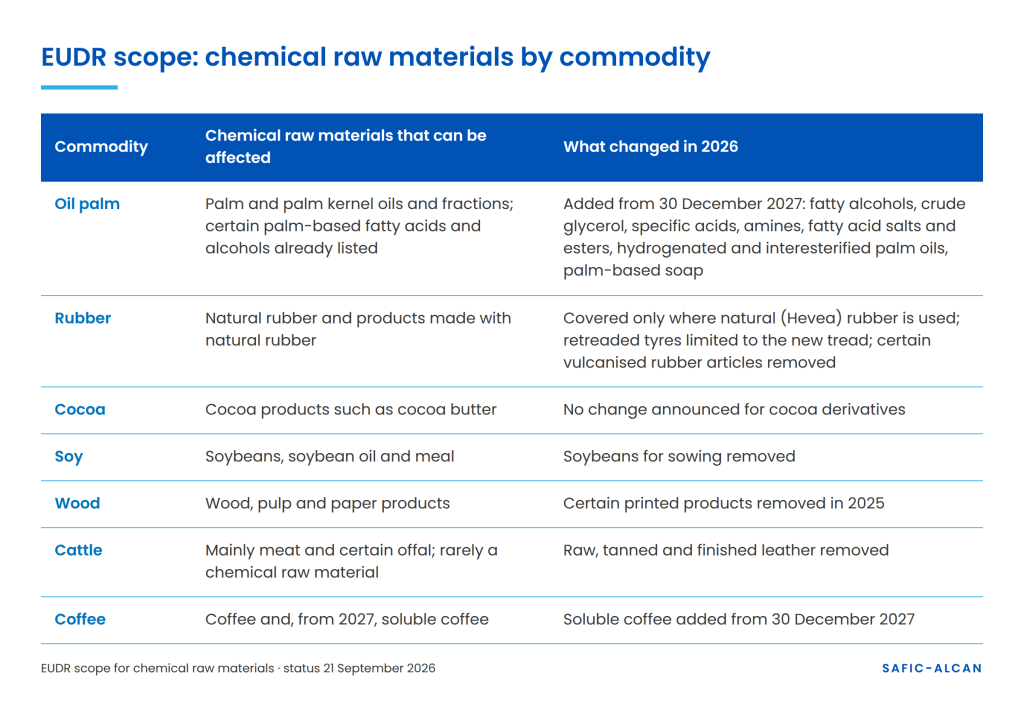
The palm additions matter most for chemical buyers. Until now Annex I captured palm oil and some of its direct derivatives, but not the full range of oleochemicals that end up in cosmetics, detergents and lubricants. From 30 December 2027, many of these will be covered where oil palm was used to make them.
Which of your raw materials fall under the EUDR?
Send us the list of grades you buy. Safic-Alcan will gather the customs code and EUDR information available from the manufacturers we represent.
What is excluded from the EUDR scope
Your role decides your obligations
Who carries the full due diligence depends on where you sit in the chain. Primary operators that are medium or large enterprises must carry out full due diligence: gathering information, assessing risk and mitigating it. The 2025 amendment created a lighter category for downstream operators, who place on the market products made from products already covered by a due diligence statement (Stibbe). Micro and small primary operators can use a simplified one-off declaration (Hogan Lovells).
Scoping your raw materials is the first step either way. Our guide to sourcing specialty chemicals in Europe covers the wider supply chain questions, and our REACH 2026 update the other regulatory changes arriving at the same time.
A scoping checklist for chemical buyers
- List every raw material derived, even partly, from palm, rubber, cocoa, soy, wood, cattle or coffee.
- Collect the CN code for each grade and check it against Annex I, including the 2026 additions.
- Ask suppliers whether the grade is made using the commodity. Many oleochemicals exist in palm-based and non-palm versions under the same code.
- Separate 2026 from 2027. Materials already listed need to be ready by 30 December 2026; newly added palm derivatives by 30 December 2027.
- Confirm your role for each material: operator, downstream operator or trader, and whether micro and small rules apply.
Preparing for 30 December 2026?
Our regulatory and supply teams can help you map EUDR exposure across the grades you buy from us.
For more on responsible sourcing, see our articles on sustainable chemistry and bio-based emollients. If you also manage cosmetic compliance, our CPSR documents checklist covers the supplier documents for your safety reports.
Frequently asked questions
Has the EUDR been delayed again?
Not since December 2025. In May 2026 the Commission confirmed that the text will not be reopened. The EUDR applies from 30 December 2026 for large and medium operators and from 30 June 2027 for most micro and small operators.
Which commodities does the EUDR cover?
Cattle, cocoa, coffee, oil palm, rubber, soy and wood, and the derived products listed by customs code in Annex I of Regulation (EU) 2023/1115.
Are palm-based oleochemicals covered?
Some already are, where their customs code is listed in Annex I. A delegated act adopted in July 2026 adds more, including fatty alcohols, crude glycerol and certain fatty acid esters made using palm, from 30 December 2027.
Is synthetic rubber covered by the EUDR?
No. Rubber entries apply only where natural (Hevea) rubber was used to make the product.
Are samples covered by the EUDR?
No. Samples and goods used for testing are outside scope.