



Quick answer: Sustainable chemistry rests on three levers that formulators can combine, not choose between: bio-based feedstocks that replace fossil carbon, circular material flows that keep resources in use through recycling and mass balance certification, and REACH compliance that sets the legal floor for any substance placed on the EU market. None of the three works in isolation. A bio-based ingredient still has to clear REACH registration, and a circular feedstock still needs a genuine environmental case, not just a marketing one.
Sustainable chemistry in specialty chemicals
Sustainable chemistry is the practice of designing, sourcing and formulating chemical substances so that they reduce dependency on virgin fossil carbon, minimise waste and toxicity across their life cycle, and comply with the regulatory frameworks that govern their use, principally REACH in the European Union. For a distributor and formulator audience, it is less a single technology than a set of sourcing and compliance decisions made project by project: which feedstock to specify, which certification to ask a supplier for, and which regulatory obligations follow from that choice.
The term is often used loosely alongside green chemistry. The two overlap but are not identical.
Sustainable chemistry versus green chemistry
Green chemistry, as originally framed by Paul Anastas and John Warner, is a design discipline: it asks how to make a chemical reaction or process inherently less hazardous, using its twelve principles as a checklist (atom economy, safer solvents, catalysis, and so on). Sustainable chemistry is broader. It includes green chemistry principles but also covers feedstock origin (bio-based or fossil), end-of-life circularity, and regulatory compliance across the whole value chain, not just the synthesis step. In practice, a formulator asking "is this ingredient sustainable" is usually asking a question that spans all three areas covered in this guide, not just process design.
Bio-based chemistry: definition and scope
A bio-based chemical is one in which some or all of the carbon originates from recently living biomass (plants, agricultural residues, algae, or biogenic waste) rather than from fossil petroleum. The distinction matters because bio-based is not automatically synonymous with biodegradable, non-toxic, or REACH-exempt: a bio-based molecule still has to be registered and evaluated on its own hazard profile.
Measuring and certifying bio-based content
Bio-based carbon content is quantified through radiocarbon analysis under ASTM D6866, which measures the ratio of carbon-14 (present in recent biomass, absent in fossil carbon) to total organic carbon in a sample, expressed as a percentage. This is the analytical backbone behind most bio-based labelling schemes, including the USDA BioPreferred Program and TÜV Austria's OK Biobased mark.
Alongside physical bio-based content, the industry also uses mass balance certification, most commonly through ISCC PLUS, to track a bio-based or recycled input through a shared production process and attribute a proportional share of output to a specific customer order, even when the physical molecules are mixed with conventional feedstock on the production line. This is how many polymer and specialty chemical producers offer bio-attributed grades without rebuilding dedicated plants. When evaluating a supplier claim, it is worth asking explicitly whether a "bio-based" grade is physically segregated, mass-balance attributed, or based on a book-and-claim credit system, since the practical implications for a customer's own carbon accounting differ.
Sectors adopting bio-based ingredients fastest
Market sizing for bio-based chemicals varies significantly depending on scope (bioplastics only versus the full chemical portfolio), which is worth flagging rather than repeating a single figure as fact. Fortune Business Insights put the global market at roughly 110 billion US dollars in 2025, growing near 9.6% a year to 2034, while Precedence Research estimated a similar 2025 base with Europe holding around half of global share. Independent of forecast scope, Cefic's indicators put bio-based chemicals turnover at 6 to 8% of total EU chemicals industry turnover today, which is a useful grounded baseline against which to read the more bullish market forecasts. Packaging, paints and coatings, cosmetics, and personal care are consistently cited as the applications adopting bio-based grades fastest, largely because drop-in bio-based polymers and emollients can substitute for fossil equivalents without reformulating the whole product.
Circular chemistry: closing the loop on feedstock
Circular chemistry means keeping carbon and material value in use for as long as possible through recycling, reuse, and alternative feedstock, rather than routing waste to landfill or incineration and drawing exclusively on virgin fossil resources for new production. For a deeper look at how this applies specifically to specialty chemical sourcing, see our dedicated piece on circular economy models for chemical distribution.
Chemical recycling versus mechanical recycling
Mechanical recycling physically reprocesses plastic waste (sorting, washing, shredding, extruding) without altering its chemical structure, which limits it to relatively clean, single-polymer waste streams. Chemical recycling breaks polymers back down to monomers or feedstock-grade molecules through processes such as pyrolysis or depolymerisation, which allows it to handle mixed or contaminated waste streams that mechanical recycling cannot process, and to output feedstock of virgin-equivalent quality. Cefic frames the two as complementary rather than competing routes, with chemical recycling positioned specifically for the harder-to-recycle fraction of plastic waste.
The EU Circular Economy Act and chemical suppliers
The Circular Economy Act is part of the European Commission's Chemicals Industry Action Plan, published in July 2025, and is intended to unlock markets for secondary raw materials, including recycled and chemically recycled feedstock, by clarifying when recyclate stops being classified as waste. As of mid-2026 the initiative has moved into its implementation phase alongside related measures such as the Circular Plastics Alliance relaunch and new EU rules on recycled content tracking. For chemical distributors and formulators, the practical consequence is a clearer legal pathway for specifying recycled-content feedstock across borders, which today is complicated by inconsistent waste classification between member states.
REACH compliance: the regulatory backbone
REACH, Regulation (EC) No 1907/2006, is the EU framework requiring companies to register, evaluate and, for the most hazardous substances, seek authorisation for chemicals manufactured or imported above one tonne per year. No sustainable chemistry initiative, bio-based or circular, replaces this obligation: a substance still has to clear REACH on its own hazard and exposure profile regardless of its carbon origin.
REACH regulation changes in 2026
On 27 April 2026, the European Commission confirmed it would not proceed with the comprehensive REACH revision that had been under discussion since 2020 under the Chemicals Strategy for Sustainability, following pushback over competitiveness concerns from parts of the European chemical industry. This does not mean REACH is static: the Candidate List of Substances of Very High Concern kept expanding through the year, and Annex XVII restrictions, including new PFAS-related entries, continued to move forward. We track these updates in detail, including the current SVHC count and specific substances added, in our dedicated brief on 2026 REACH updates.
REACH obligations for formulators and distributors
A formulator sourcing a substance above the one-tonne threshold, or an article containing a Candidate List substance above 0.1% by weight, has communication and, in some cases, notification obligations that exist independently of any sustainability claim attached to the substance. In practice this means treating REACH status as a baseline filter applied before evaluating bio-based content or circularity credentials, not after.
Bio-based, circular and conventional feedstock compared
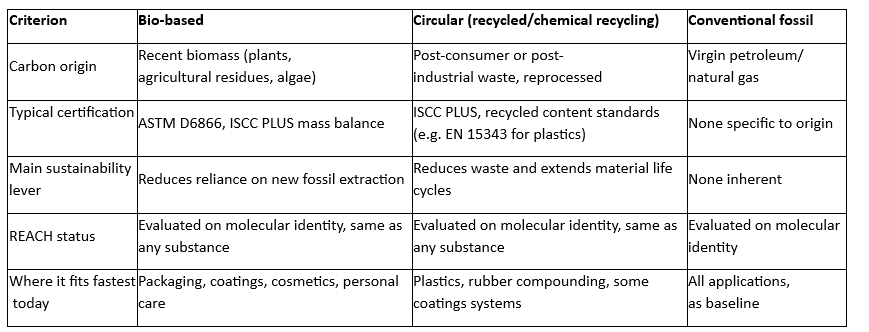
Building a sustainable chemistry approach as a formulator
Start from the application, not the label. A bio-based emollient that performs worse than its fossil equivalent, or a recycled-content polymer that fails a mechanical spec, does not advance a sustainability goal, it just creates a product problem. Three practical steps help avoid that:
First, ask suppliers for the certification behind any bio-based or circular claim, physical segregation, mass balance, or book-and-claim, rather than accepting the label alone. Second, confirm REACH status independently of the sustainability claim: registration status, SVHC presence, and any Annex XVII restriction apply regardless of carbon origin. Third, where a switch to bio-based or recycled feedstock is being evaluated for plastics and rubber applications, validate performance data (mechanical, thermal, ageing) against the incumbent grade before committing to a reformulation, since drop-in equivalence is common but not universal.
For the regulatory reasoning behind a broader shift toward more accountable sourcing across our own supply chain, our piece on responsible chemistry sets out how this connects to distributor-level sourcing decisions.
FAQ
Is sustainable chemistry the same as green chemistry?
No. Green chemistry is a process design discipline focused on reducing hazard in chemical synthesis. Sustainable chemistry is broader and includes feedstock origin, circularity, and regulatory compliance across the value chain.
Did the EU cancel the REACH revision in 2026?
The European Commission confirmed on 27 April 2026 that it would not proceed with the comprehensive REACH revision proposed under the Chemicals Strategy for Sustainability. Existing REACH obligations, including SVHC Candidate List updates and Annex XVII restrictions, continue to apply and evolve.
Is a bio-based ingredient automatically exempt from REACH?
No. Bio-based origin has no bearing on REACH registration or restriction status. Every substance is evaluated on its own hazard and exposure profile, whichever feedstock it comes from.
What is mass balance certification?
Mass balance, most commonly certified under ISCC PLUS, is an accounting method that allows a bio-based or recycled input mixed with conventional feedstock during production to be proportionally attributed to specific customer orders, without requiring physical segregation of the molecules.
What is the difference between mechanical and chemical recycling?
Mechanical recycling physically reprocesses plastic waste without changing its chemical structure and works best on clean, single-polymer streams. Chemical recycling breaks polymers down to monomer or feedstock level, which allows it to process mixed or contaminated waste and to output virgin-equivalent feedstock.