



Two certificates of analysis, every line within limits, same INCI or same CAS number. The purchasing case looks obvious, and then the pilot batch behaves differently. This is the most common disappointment in raw material switching, and it has a simple cause: a specification describes what someone decided to measure, not everything that matters.
Quick answer
- Specification equivalence means the measured parameters match. Performance equivalence means the material does the same job in your process.
- What usually differs: impurity profile, particle size distribution, surface treatment, moisture, polymer distribution and process history.
- A drop-in claim is only meaningful with the test conditions attached.
- Build the equivalence protocol before the trial, with the acceptance criteria written down.
What a specification does not tell you
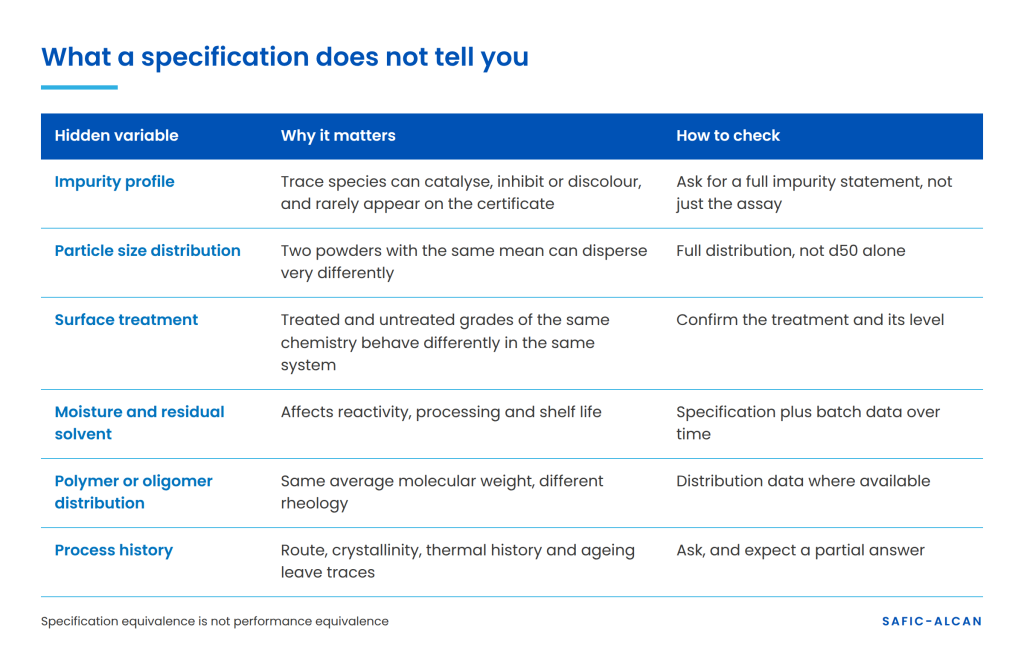
None of this makes the specification useless. It makes it a necessary first filter rather than a conclusion. A candidate that fails the specification is out; a candidate that passes has earned a trial, not an approval.
Comparing two grades on paper?
Send us both specifications. Safic-Alcan can tell you what is missing from the comparison and what to request from the manufacturer.
An equivalence protocol that holds up
- Define the use case. The same raw material can be equivalent in one formula and not in another. Equivalence is always relative to an application.
- Write the acceptance criteria first, with limits, before anyone sees a result.
- Keep the incumbent as the control and run it in parallel, from the same production conditions.
- Test at three levels: the material itself, the intermediate (dispersion, premix, compound) and the finished product, including ageing.
- Record the conditions, because that is what makes the conclusion reusable, and what a customer or auditor will ask for.
This is also what turns a switch into a documented decision. Without the conditions, "we tested it and it worked" is not evidence, and it cannot be defended two years later when a complaint arrives.
The regulatory layer people forget
Equivalence in performance says nothing about equivalence in obligations. A REACH registration belongs to a legal entity, so it does not travel with the material: changing supplier means confirming that your new supplier, or its only representative, covers your volume (European Commission, Your Europe). Safety data sheets have to be reissued by the new supplier for the market where the product is placed (ECHA). In regulated applications, the documentation package is part of the equivalence, not an administrative afterthought: our CPSR documents checklist lists what a cosmetic safety assessor will need from the new source.
What "drop-in" should mean
Suppliers and distributors, including us, use the phrase. It is only useful with three things attached: the application it was demonstrated in, the criteria that were met, and the conditions of the test. Without them, it is a hope. A fair claim sounds like this: in a waterborne system at this dosage, this grade matched the incumbent on these three criteria, tested in this way. Anything shorter belongs in a conversation, not in a decision.
If the switch was forced on you rather than chosen, our guide on what to do when a supplier discontinues a grade covers the first week, and our cosmetic ingredient substitution guide covers the shortlist stage. On roles and who carries what, see what a distributor can and cannot do on your regulatory behalf.
Qualifying a second source?
We can help you structure the comparison and provide the documentation available from the manufacturers we represent.
Frequently asked questions
What is the difference between specification and performance equivalence?
Specification equivalence means the measured parameters of two materials match. Performance equivalence means the new material does the same job in your formula or process, which the specification alone cannot demonstrate.
If both certificates of analysis match, why would the result differ?
Because certificates report what was measured. Impurity profile, particle size distribution, surface treatment, moisture and process history often differ without breaching any specification line.
Is a drop-in replacement ever real?
Yes, but only relative to an application and a set of criteria that were tested. A drop-in claim without its test conditions is not verifiable.
Does the REACH registration follow the material?
No. Registration belongs to a legal entity. When you change supplier, you have to confirm that the new supplier, or its only representative, holds the relevant registration for your volume.
How many batches should I test?
Enough to see batch to batch variation of the new source, not one. A single batch tells you the candidate can work, not that it will.