


Cyclopentasiloxane, better known as D5, has been the quiet workhorse of leave-on cosmetics for decades: it spreads a formula, carries actives and film formers onto the skin, then evaporates and leaves a dry, silky finish. From 6 June 2027, cosmetic products placed on the EU market can no longer contain it at 0.1% or more.
There is no single drop-in replacement. The formulators who reformulate fastest are the ones who first work out which job D5 was doing in their formula, then rebuild that job with a blend. This guide shows how.
Quick answer
- D5 is a volatile cyclic silicone used as a carrier, spreading agent and dry-touch emollient.
- Under REACH entry 70, D5 has been limited to below 0.1% in wash-off cosmetics since 31 January 2020. The same limit applies to all other cosmetic products, including leave-on, after 6 June 2027.
- No single ingredient reproduces D5. Replacements are built from volatile hydrocarbons for flash-off, light alkanes and esters for slip and spreading, and sometimes low-viscosity linear silicones.
- Map the function first, then blend, then test evaporation, sensory and stability against your current D5 benchmark.
What is cyclopentasiloxane, and what does it do in a formula?
Cyclopentasiloxane (INCI) is a cyclic siloxane with five silicon-oxygen units. It belongs to the family covered by the INCI name cyclomethicone, together with D4 and D6. What makes it useful is a combination of properties that rarely come together: it is clear, odourless, has low surface tension, and it evaporates slowly after application. It also stays liquid in cold storage: D5 has a solidification point of about minus 40 °C and a boiling point of about 210 °C, which is why it replaced D4 in many formulas (USPTO).
Its volatility is slower than most people assume. In an evaporation test published in Cosmetics & Toiletries, D5 took about 400 minutes to evaporate completely, roughly twice as long as water under the same conditions. And the dry feel formulators value is not only a matter of evaporation: viscosity, surface tension, flammability and effect on the skin all play a role (Personal Care Magazine). That is why a replacement chosen on volatility alone usually disappoints.
Is cyclopentasiloxane banned in the EU? What the rule says, and when
The restriction comes from REACH, not from the Cosmetics Regulation. Commission Regulation (EU) 2024/1328 replaced entry 70 of Annex XVII of REACH. It rests on the environmental profile of these substances: D4, D5 and D6 were identified in 2018 as substances of very high concern with very persistent and very bioaccumulative properties (EUR-Lex).
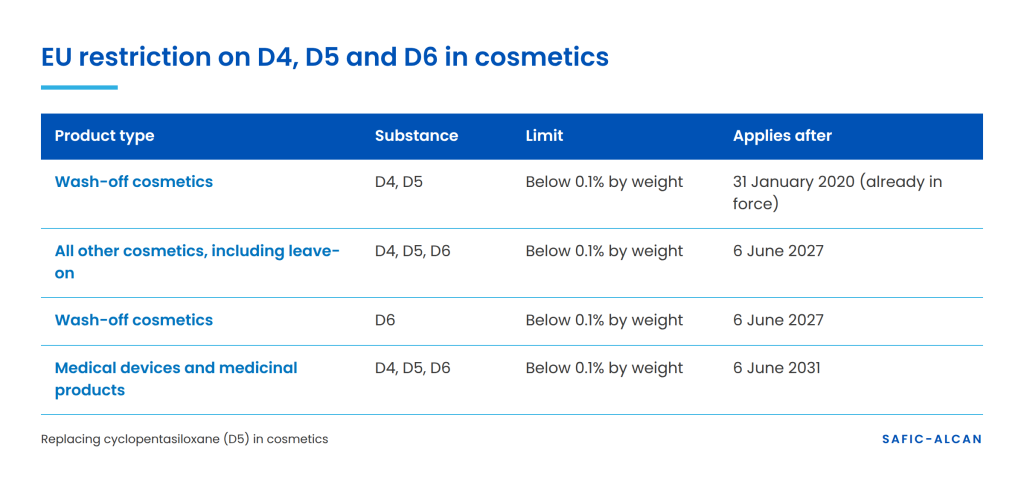
Two points are often missed. First, the limit applies to the concentration in the finished product, whatever the source, so residual D4, D5 or D6 carried in by other silicone raw materials counts. Ask your suppliers for a statement on residual cyclic siloxanes. Second, this is an environmental measure. The EU Scientific Committee on Consumer Safety concluded in 2016 that D5 is safe in cosmetic products, except in hair and sunscreen aerosols, provided it is highly pure. Consumer safety is not the reason for reformulating; compliance and emissions are.
That SCCS position is summarised in a 2024 study on bio-based D5 alternatives.
Start with the function, not the ingredient
Before comparing alternatives, write down what D5 does in your formula. In most products it does two or three of these jobs at once, and each job points to a different replacement chemistry.
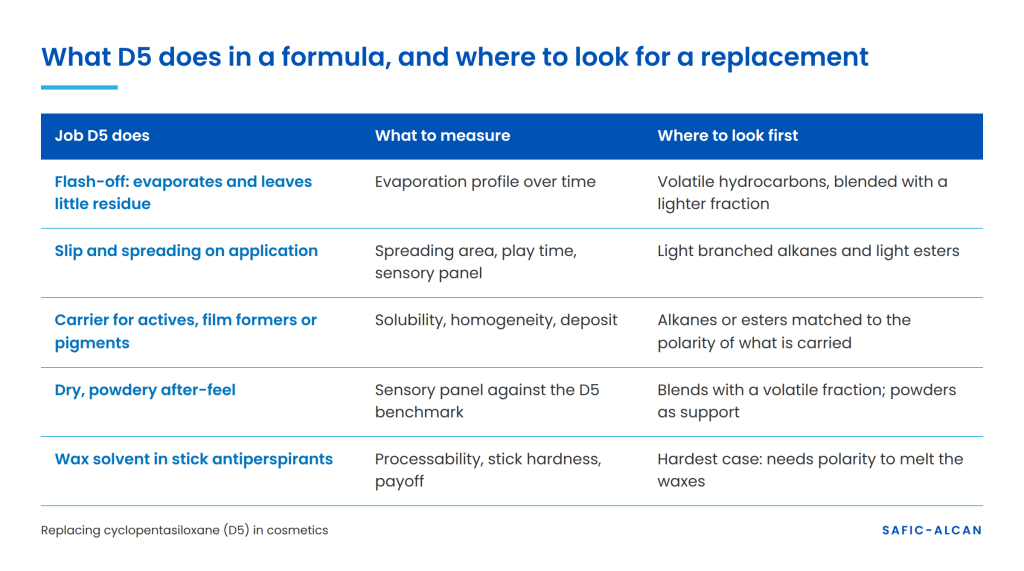
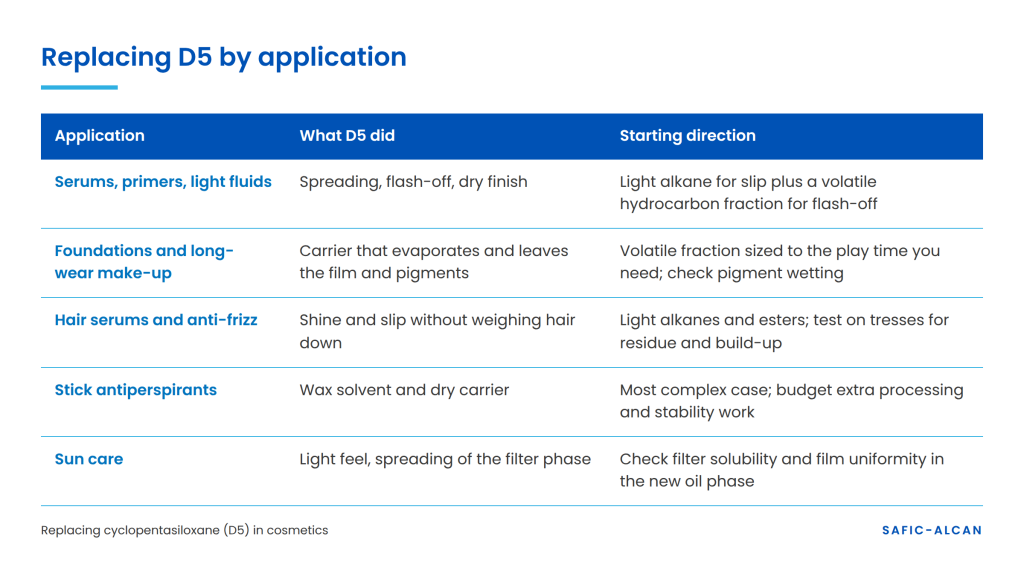
The stick antiperspirant case deserves a warning. D5 is used there partly because it melts the waxes during processing. A 2020 patent notes that there is no readily available alternative that is both safe and chemically compatible, and that low-viscosity dimethicone on its own lacks the polarity to melt the waxes and keep the stick processable (USPTO). Plan more development time for this format.
The replacement options compared
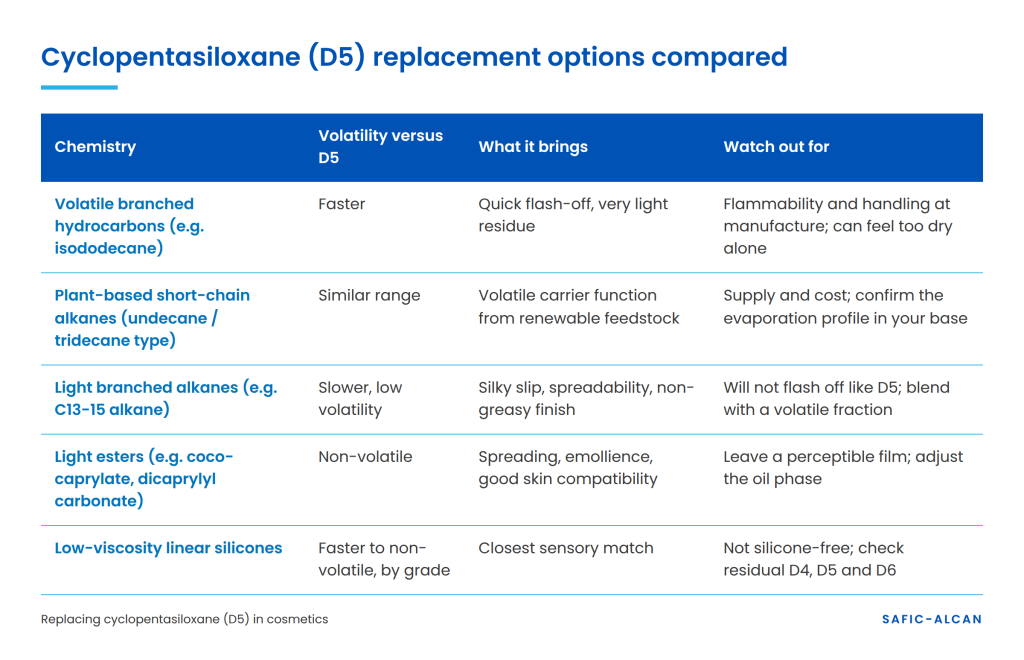
On linear silicones, the same Cosmetics & Toiletries test found a 0.65 cSt disiloxane evaporated faster than water, while 2 cSt and 5 cSt fluids behaved as non-volatile (Cosmetics & Toiletries). On esters, a 2024 study compared six biosynthesised esters with D5 in a commercial formulation to identify the most promising substitutes (ScienceDirect). Treat this table as a starting shortlist: every option needs to be tested in your own base against your current product.
Not sure which blend matches your D5 formula?
Send us your current formula or INCI list. Safic-Alcan cosmetic specialists will suggest a starting blend for your format and test plan.
Replacing D5 by application
A six-step reformulation workflow
- Audit. List every product containing D4, D5 or D6, including residues carried in by other silicone raw materials. Ask suppliers for a residual cyclic siloxane statement.
- Benchmark. Keep the current D5 product as the reference. Record its sensory profile with a trained panel and its evaporation curve.
- Map the function. Use the table above to decide whether you are replacing flash-off, slip, carrier function, after-feel or wax solvency.
- Blend and screen. Build two or three candidate blends. Screen evaporation with a simple gravimetric test, then sensory against the benchmark.
- Stability. Run stability on the lead candidate. Oil-phase changes can shift viscosity, emulsion stability and pigment dispersion.
- Documentation. Update the safety assessment, product information file and claims before the product is placed on the market after 6 June 2027.
Planning a D5 reformulation before June 2027?
Safic-Alcan can source samples of candidate emollients and share formulation starting points for your product type.
Where Neossance™ Hemisqualane fits
Neossance™ Hemisqualane is a C13-15 alkane produced by fermentation of sugarcane, through the same farnesene route used for Neossance™ Squalane. Its role in a D5 replacement is slip, spreadability and a non-greasy finish. It is described as a non-volatile emollient, so on its own it will not reproduce the flash-off of D5: combine it with a volatile fraction when evaporation matters. Safic-Alcan distributes Neossance™ Hemisqualane for skin, sun and body care, make-up, antiperspirants, deodorants and hair conditioners. Our guide to squalane and hemisqualane covers the ingredient in more detail.
For the wider picture on silicone-free formulation, see our guide to silicone alternatives in cosmetics, and for the role of each silicone grade, silicone grades explained. If you are rebuilding texture in colour cosmetics, our guide to sensory modifiers is the next step.
Frequently asked questions
What is cyclopentasiloxane?
Cyclopentasiloxane (D5) is a volatile cyclic silicone used in cosmetics as a carrier, spreading agent and dry-touch emollient. It evaporates slowly after application and leaves a silky finish.
Is cyclopentasiloxane banned in the EU?
It is restricted, not banned as an ingredient name. Under REACH entry 70, cosmetic products may not contain D5 at 0.1% or more by weight: since 31 January 2020 for wash-off products, and after 6 June 2027 for all other cosmetic products, including leave-on.
Is cyclopentasiloxane safe on skin?
The EU Scientific Committee on Consumer Safety concluded in 2016 that D5 is safe in cosmetic products, except in hair and sunscreen aerosols. The EU restriction is based on its persistence and bioaccumulation in the environment, not on consumer safety.
Is cyclomethicone the same as cyclopentasiloxane?
Cyclomethicone is an INCI name covering a family of cyclic siloxanes, including D4, D5 and D6. Cyclopentasiloxane is the specific five-unit member of that family.
What is the best replacement for cyclopentasiloxane?
There is no single best replacement. Most successful reformulations combine a volatile hydrocarbon for flash-off with a light alkane or ester for slip, and are tested against the original D5 product.