



A request we see every week: a brand is finalising the cosmetic product safety report (CPSR) for a new launch and asks for the technical data sheet, the latest safety data sheet and the certificate of analysis for one of its raw materials. Those three documents are a good start, but they are not what a safety assessor needs to close the report. This guide maps each section of the CPSR to the supplier documents that feed it, so you can ask for everything once, early, and avoid last-minute gaps before launch.
Quick answer
- A CPSR is required for every cosmetic product placed on the EU market. Part A gathers the safety data; Part B is the assessment signed by a qualified safety assessor.
- From each raw material supplier you typically need: full composition, specification with test methods, certificate of analysis, microbiological specification where relevant, purity and impurity information, toxicological data and regulatory statements.
- The SDS, TDS and CoA alone do not cover the composition, impurity and toxicological sections of Part A.
Request documents per grade, check they match the batch you will use, and request them again when a supplier, a specification or a regulation changes.
What is a CPSR?
The cosmetic product safety report is the core of the product information file that the responsible person must hold for every cosmetic product placed on the EU market. Its content is set by Annex I of Regulation (EC) No 1223/2009 and explained in the Commission guidelines of 2013 (Implementing Decision 2013/674/EU).
- Part A, safety information: composition, physical and chemical characteristics and stability, microbiological quality, impurities and packaging, use, exposure, toxicological profile of the substances, undesirable effects and other information.
- Part B, safety assessment: the conclusion, labelled warnings, the reasoning, and the credentials and signature of the safety assessor.
The product information file must be kept available to the authorities for 10 years after the last batch of the product is placed on the market. The safety assessor must hold a university qualification in pharmacy, toxicology, medicine or a similar discipline, or one recognised as equivalent by a Member State.
Why the SDS, TDS and CoA are not enough
Each of these documents answers a different question, and none of them answers the consumer safety question on its own.
- The safety data sheet communicates hazards for handling the raw material at work. It gives the classification, which the safety assessor uses, but not the toxicological data, impurity profile or full composition the CPSR needs.
- The technical data sheet describes what the ingredient does and how to use it. It is useful context, not safety evidence.
- The certificate of analysis confirms that one batch meets the specification. The CPSR also needs the specification itself and the methods behind it.
The Commission guidelines are explicit on where the rest should come from: for impurities and packaging, data from suppliers are described as of crucial importance and should be preferred, and safety and quality data held by raw material suppliers should be shared with the cosmetic manufacturer (Implementing Decision 2013/674/EU).
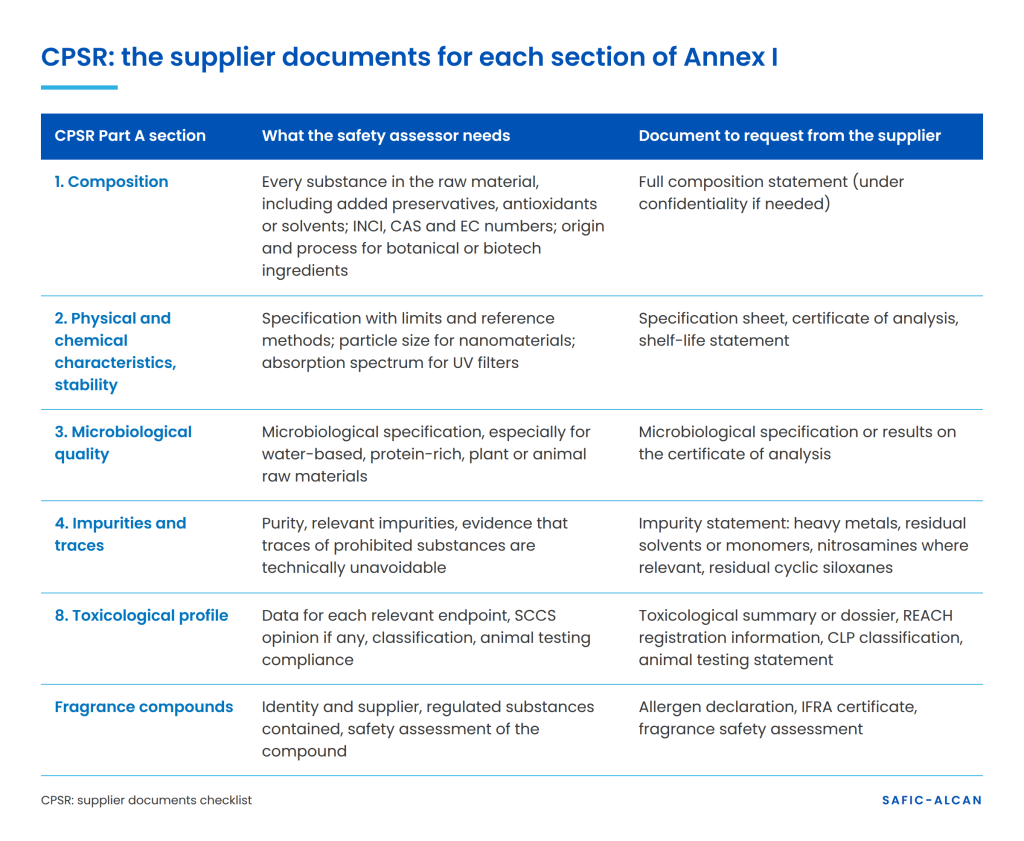
Sections 5, 6, 7, 9 and 10 of Part A (normal and foreseeable use, exposure, undesirable effects, other information) are built by the brand, the manufacturer and the safety assessor, not by the raw material supplier.
One practical example: if you are replacing D5 before June 2027, ask silicone suppliers for their residual D4, D5 and D6 content, because the limit applies to the finished product. Our guide on how to replace cyclopentasiloxane explains why.
Missing a document for your CPSR?
Tell us which raw materials and grades are in your formula. Safic-Alcan will gather the documentation available from the manufacturers we represent.
Regulatory statements safety assessors often ask for
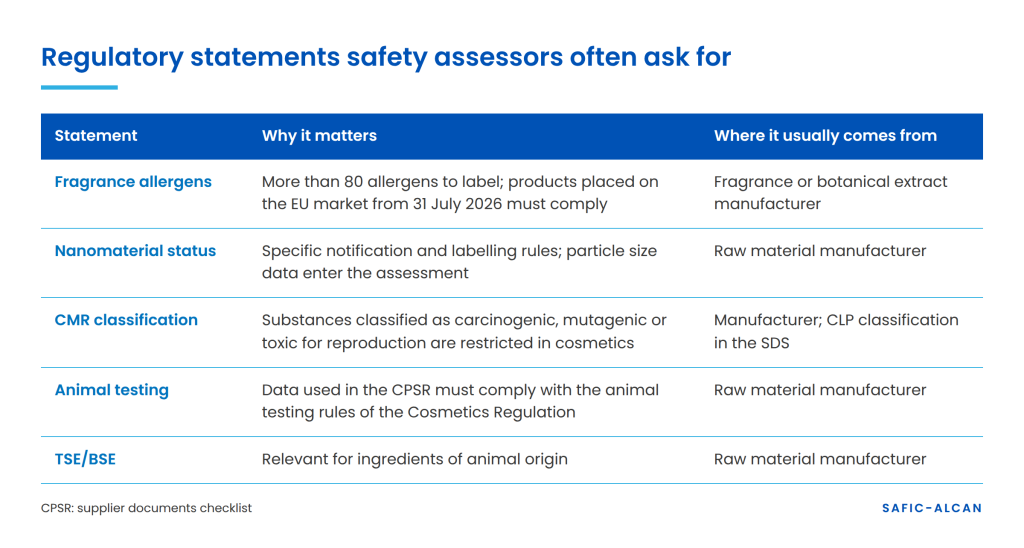
On allergens: Regulation (EU) 2023/1545 requires labelling above 0.001% in leave-on and 0.01% in rinse-off products. Products placed on the market from 31 July 2026 must comply, and products already on the market can be made available until 31 July 2028 (UL Solutions). Ask fragrance and botanical suppliers for declarations against the extended list, not the old one.
Commercial statements such as vegan, halal or kosher can be useful to your customers, but they are not CPSR requirements.
How to organise the request
- List every raw material per formula with its exact grade, supplier and manufacturer. Documents are grade-specific.
- Send one consolidated request per raw material using the checklist above, instead of asking document by document.
- Check that documents match what you will use: current specification, certificate of analysis for the production batch, not an old sample batch.
- Handle confidential composition early. When a manufacturer will not disclose full composition to you, ask whether it can go directly to your safety assessor under a confidentiality agreement.
- Keep versions and dates. The report must be kept up to date, and the file kept for 10 years after the last batch.
- Request again when something changes. The guidelines call for a review when raw material specifications or legal requirements change, for example new limits in the annexes of the Cosmetics Regulation.
To follow changes in the annexes, see our update on what is changing in the EU Cosmetics Regulation annexes and our guide to preservatives in cosmetics. For changes under REACH, see REACH 2026 restricted substances.
What a distributor can and cannot do for your CPSR
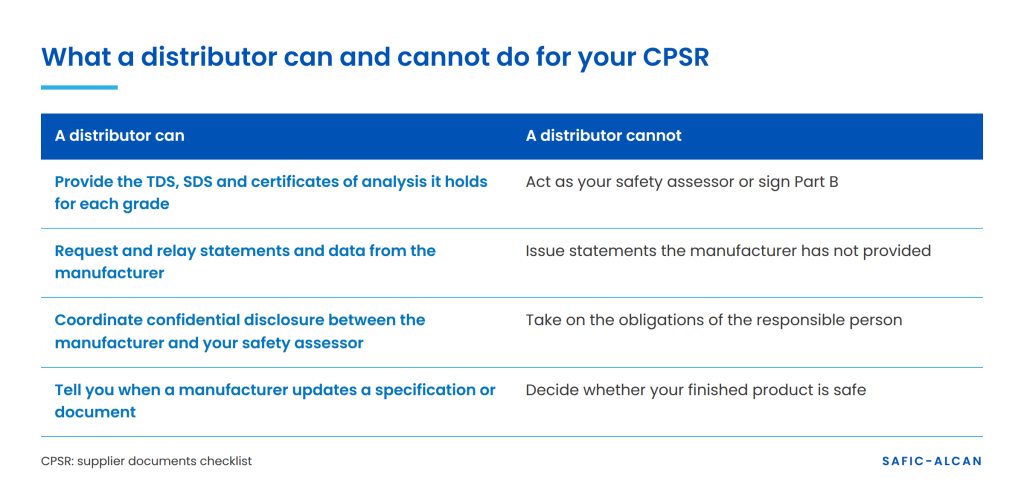
Read more about the role of a specialty distributor in why specialty chemical distributors matter. Product pages in our online catalogue give access to technical documentation and let you request what you need for each grade.
Frequently asked questions
What is a CPSR?
A cosmetic product safety report is the safety assessment required by Article 10 and Annex I of Regulation (EC) No 1223/2009 for every cosmetic product placed on the EU market. It has two parts: the safety information (Part A) and the safety assessment signed by a qualified assessor (Part B).
Who can sign a CPSR?
A safety assessor holding a university qualification in pharmacy, toxicology, medicine or a similar discipline, or a qualification recognised as equivalent by an EU Member State.
Is a safety data sheet enough for a CPSR?
No. The SDS provides the hazard classification of the raw material for workplace handling. The CPSR also needs the full composition, specification, impurity information and toxicological data.
How long must the product information file be kept?
For 10 years after the last batch of the product is placed on the market, and it must be readily accessible to the competent authorities.
When does a CPSR need to be updated?
When new safety data become available, when the formulation or raw material specifications change, when conditions of use change, when undesirable effects increase, or when legal requirements change.