



Knowing that a product is in scope is the easy half. The harder half is the evidence: where exactly the commodity was produced, that it was produced legally, and that the land was not deforested. The EUDR applies from 30 December 2026 for large and medium operators, so the collection work has to start well before the first shipment of 2027. This guide sets out what has to be gathered, who has to gather it, and what the lighter regimes actually cover. For which products are caught, see our EUDR scope guide.
Quick answer
- Due diligence has three steps: collect information, assess the risk, and mitigate it until the risk is negligible.
- The information includes geolocation of the plots where the commodity was produced, with the production dates.
- The operator placing the product on the market submits a due diligence statement in the EU information system.
- The 2025 amendment created a lighter regime for downstream operators, who work from statements already submitted upstream.
- Certification schemes can support the risk assessment, but they do not replace the operator’s own due diligence.
Who does what
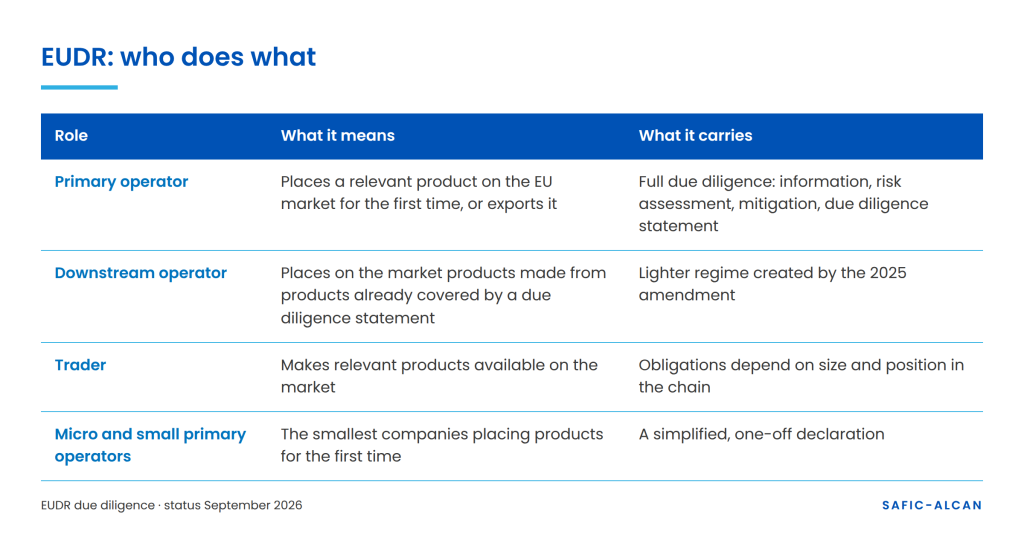
The downstream operator category came in with Regulation (EU) 2025/2650 (Stibbe), and the simplified declaration for micro and small primary operators is part of the same simplification package (Hogan Lovells). Getting your own role right is the first task: the obligations differ substantially.
Step 1: collect the information
The regulation requires traceability back to the plots of land where the commodity was produced, with geolocation (Timber Trade Portal). In practice, the file for each batch holds:
- Description, quantity and country of production of the commodity or product.
- Geolocation of all plots where the commodity was produced, with the date or time range of production.
- Evidence that the land was not deforested after the cut-off date.
- Evidence that production complied with the relevant legislation of the producing country: land use rights, environmental, labour, tax, anti-corruption and third-party rights.
- The names and contacts of suppliers and of the customers you supply.
The difficulty is rarely the format. It is that the data sits several steps upstream, often with actors who have never been asked for it, and that mixed loads in silos, warehouses or mills break the link between batch and plot.
Need the origin data for the raw materials you buy from us?
Tell us which grades are concerned. Safic-Alcan will gather the information available from the manufacturers we represent.
Step 2: assess the risk, step 3: mitigate it
The risk assessment weighs the country and region of production, the complexity of the supply chain, the reliability of the information and the risk of mixing with unknown material. Where the risk is more than negligible, mitigation follows: additional information, independent audits, supplier capacity building, or a decision not to source that batch.
Certification is often presented as the answer. It is not, by itself: schemes can support the risk assessment, and the Commission is building a database of certification schemes as part of the implementation package, but the obligation remains with the operator (Hogan Lovells).
The due diligence statement, and the reference number
Before placing a relevant product on the market, the operator submits a due diligence statement in the EU information system and receives a reference number. Downstream actors work from those reference numbers rather than repeating the full exercise. The Commission adopted an implementing act on the information system in July 2026, alongside the delegated act updating the product list (European Commission and Linklaters).
Two practical points follow. First, ask your suppliers now whether they will provide a reference number, and for which products. Second, keep the statements: they are the evidence that your own placing on the market was covered (Covington).
A realistic preparation plan
- Confirm your role for each product: primary operator, downstream operator or trader.
- Map the products in scope by customs code, using the scope guide, and separate the 2026 deadline from the 2027 additions.
- Write to each supplier with a single, specific request: geolocation, legality evidence, and whether a due diligence statement reference number will be provided.
- Decide where the data will live. Geolocation files are not a spreadsheet attachment problem at scale.
- Test the chain on one product before the deadline, end to end, including the statement submission.
If a supplier cannot provide the data, that is a sourcing decision rather than a paperwork problem, and it is better discovered in October than in December. Our article on sourcing specialty chemicals in Europe covers the alternatives, and our guide to what a distributor can and cannot do on your regulatory behalf sets out where we can help and where we cannot.
Preparing for 30 December 2026?
Safic-Alcan can help you map which of the grades you buy from us are in scope and what documentation is available.
Frequently asked questions
What are the three steps of EUDR due diligence?
Collecting information, assessing the risk, and mitigating it until it is negligible. The operator then submits a due diligence statement before placing the product on the market.
What information has to be collected?
Description and quantity, country of production, geolocation of the plots with production dates, evidence that the land was not deforested after the cut-off date, evidence of legal production, and supplier and customer details.
Does a certification replace due diligence?
No. Schemes can support the risk assessment, but the legal obligation stays with the operator.
What is a downstream operator?
A company placing on the market products made from products already covered by a due diligence statement. The 2025 amendment gave this category a lighter regime.
When does this start?
30 December 2026 for large and medium operators, and 30 June 2027 for most micro and small operators. Products added by the July 2026 delegated act follow from 30 December 2027.