


Every cosmetic product placed on the EU market must remain microbiologically safe throughout its shelf life and period of use. Preservatives are the primary tool formulators rely on to prevent microbial contamination — but in the EU, not just any antimicrobial agent will do.
Only substances explicitly listed in Annex V of EU Cosmetics Regulation 1223/2009 may be used as preservatives in cosmetics, and only within the specific conditions set out for each entry. With several Annex V entries revised in 2026, this guide covers the full framework: how Annex V works, which preservatives it permits, their concentration limits, and how to build a compliant preservation system.
What Is Annex V of EU Cosmetics Regulation 1223/2009?
EU Cosmetics Regulation No 1223/2009 governs all cosmetic products sold within the European Union. Its structure relies on a series of annexes, each addressing a specific ingredient category:
- Annex II — Prohibited substances
- Annex III — Restricted substances (permitted under defined conditions)
- Annex IV — Permitted colorants
- Annex V — Permitted preservatives (subject of this guide)
- Annex VI — Permitted UV filters
Annex V currently lists approximately 60 entries at of August 2026, each specifying the permitted substance, maximum concentration in the finished product, scope of use, and labelling requirements. Individual entries can be verified in the COSING database maintained by the European Commission.
The key principle is a positive list: if a substance with preservative function is not listed in Annex V, it cannot be used as a preservative in EU cosmetics.
How to Read an Annex V Entry
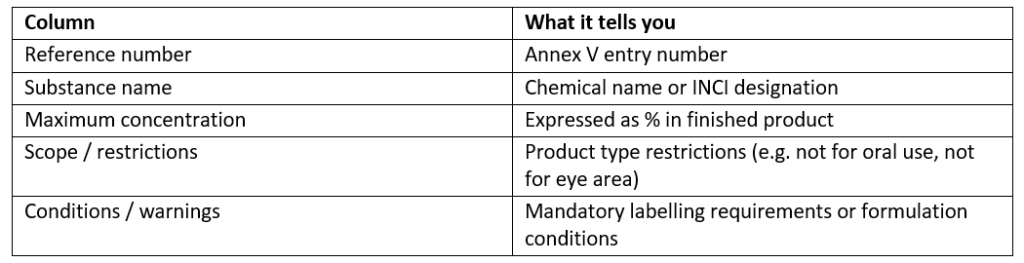
Each entry in Annex V contains several columns:
Key Preservative Categories in Annex V
Phenoxyethanol — The Industry Standard
Phenoxyethanol (INCI: Phenoxyethanol) is the most widely used cosmetic preservative in European formulations. It is listed in Annex V at a maximum concentration of 1.0% in the finished product. A restriction prohibiting its use in products for children under 3 in the nappy area was introduced following the SCCS opinion SCCS/1575/16 (2016).
Why it dominates:
- Broad-spectrum activity against bacteria and yeasts
- Good stability across a wide pH range (4–10)
- No restriction for rinse-off, leave-on, or aerosol formats (adult products)
- Well-understood safety profile at ≤1%
Parabens
Parabens are esters of para-hydroxybenzoic acid. The European Commission has assessed their safety through multiple SCCS opinions, consolidating restrictions on long-chain parabens.
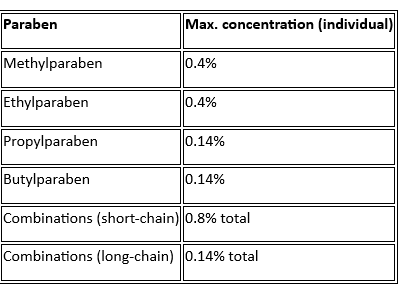
Isopropylparaben, isobutylparaben, phenylparaben, benzylparaben, and pentylparaben are prohibited under Annex II. Methylparaben and ethylparaben remain among the most thoroughly tested preservatives available, with the SCCS consistently reaffirming their safety at listed concentrations.
Benzyl Alcohol
Benzyl alcohol has a dual role — fragrance and preservation. As a preservative it is authorised at a maximum of 1.0% (Annex V). It is primarily effective against gram-positive bacteria, with activity optimal at acidic pH (typically below pH 5).. It is also a regulated fragrance allergen under Annex III, requiring on-pack labelling above 0.001% (leave-on) and 0.01% (rinse-off), per Commission Regulation (EU) 2023/1545. This dual-annex status requires careful management in the CPSR and labelling process.
Salicylic Acid
Salicylic acid is listed both as a preservative (Annex V, max. 0.5%) and as a cosmetic functional agent (Annex III). A 2023 SCCS opinion (SCCS/1662/21) informed updated restrictions: the substance is now subject to specific conditions in spray and aerosol formats. Products for children under 3 (except shampoos) are excluded.
Chlorphenesin
Chlorphenesin is authorised at up to 0.3% in the finished product. It shows primary activity against gram-positive bacteria and fungi. It is commonly combined with phenoxyethanol to deliver complementary gram-negative/gram-positive coverage, with both ingredients well within their respective Annex V limits.
Dehydroacetic Acid (DHA)
Dehydroacetic acid and its sodium salt are authorised at a maximum of 0.6% (expressed as acid). Following recent SCCS scientific opinions, their regulatory status is under continuous monitoring. Formulators should track COSING for potential amendments to entry conditions
Formaldehyde-Releasing Preservatives
Several Annex V preservatives function by slowly releasing formaldehyde as the active antimicrobial agent:

A critical 2026 change: the threshold triggering the mandatory "releases formaldehyde" label warning drops from 0.05% to 0.001%, effective July, 30th 2026. This applies to any formula containing the above preservatives. See the full analysis in the related article EU Cosmetics Regulation Annex V — What’s Changing in 2026.
Building an Effective Preservation System
No single preservative covers all microbial threats equally. Professional formulators design combination systems that:
- Achieve broad-spectrum coverage — gram-positive bacteria, gram-negative bacteria, yeasts, and moulds
- Stay within each substance’s Annex V limit — including when using pre-blended systems
- Account for formulation pH and water activity — most preservatives have an optimal activity range
- Consider the product’s risk profile — water content, intended use, packaging, and target population
Natural and Multifunctional Approaches
The clean beauty trend has driven demand for preservation strategies that avoid traditional Annex V INCI designations. Common approaches include:
- Polyols and diols (1,2-Hexanediol, Ethylhexylglycerin, Caprylyl Glycol) — used as preservation boosters
- Organic acids (levulinic acid, anisic acid) — multi-hurdle preservation strategies
- pH optimisation — formulating below pH 5.5 significantly reduces microbial growth risk
- Water activity control — relevant in anhydrous and low-water formats
Preservative Efficacy Testing: ISO 11930
Demonstrating microbiological safety is a legal requirement under EU Cosmetics Regulation. The EN ISO 11930:2019+A1:2022 standard (Evaluation of the antimicrobial protection of a cosmetic product) is the accepted methodology for preservative efficacy testing in the EU.
The test inoculates five standard challenge organisms — Staphylococcus aureus, Escherichia coli, Pseudomonas aeruginosa, Candida albicans and Aspergillus brasiliensis — and measures log reduction at days 7, 14 and 28 against two acceptance criteria, A and B. Criterion A is the target and requires the larger log reduction. Criterion B is a lower bar that the standard accepts only where additional justification demonstrates the product is sufficiently protected, for example through packaging or conditions of use. Criterion B is not assigned by product category and is not a rinse-off allowance
2026 Regulatory Summary: What has changed in Annex V
Three changes took effect in 2026, driven by CMR reclassifications under the CLP Regulation:
- New prohibitions: Trimethyl borate and N,N’-methylenediacrylamide added to Annex II, effective 1 May 2026
- Revised entry 7 for o-Phenylphenol: Sodium o-Phenylphenate added to the same entry, a combined concentration limit introduced, and new inhalation and oral product restrictions. The 0.2% rinse-off and 0.15% leave-on limits (as phenol) are unchanged
- New formaldehyde warning threshold: mandatory label warning triggered at 0.001% (down from 0.05%), effective July, 30th, 2026
FAQ
What is the maximum concentration of phenoxyethanol allowed in EU cosmetics?
The EU Cosmetics Regulation (Annex V) sets a ceiling of 1.0% for phenoxyethanol in the finished product. This covers total phenoxyethanol content from all sources in the formula.
Can parabens still be used in EU cosmetics in 2026?
Yes. Methylparaben and ethylparaben are permitted at 0.4% (as acid) for a single ester and 0.8% (as acid) for mixtures of esters. Propylparaben and butylparaben are limited to 0.14% (as acid) for the sum of the two, not 0.14% each, within an overall cap of 0.8% for mixtures of parabens. Propylparaben and butylparaben are additionally prohibited in leave-on products designed for application to the nappy area of children under three. No new paraben restrictions apply in 2026
Is salicylic acid a preservative or a cosmetic active?
Both. It has a dual function: keratolytic/exfoliant (Annex III) and preservative (Annex V, max. 0.5%). The SCCS opinion SCCS/1662/21 (2023) informed current usage conditions. The CPSR must clearly define the intended function(s).
Is preservative efficacy testing required even when using Annex V-listed substances?
Yes. Annex V listing confirms a substance is authorised — it does not certify a formula is adequately preserved. Testing per EN ISO 11930:2019+A1:2022 is required in the cosmetic product safety report (CPSR).
What does "preservative-free" mean in regulatory terms?
No formal definition exists in Regulation 1223/2009. The product must contain no Annex V substance used for its preservative function, but that alone is not sufficient. The claim is also assessed against the six common criteria in Commission Regulation (EU) No 655/2013, particularly truthfulness and honesty, and against Annex III of the Commission's Technical Document on Cosmetic Claims. Where a multifunctional ingredient is being relied upon for microbiological protection, the claim is challengeable regardless of that ingredient's Annex V status. For a comprehensive analysis, you can read our article on what "preservative-free" means in the EU.
Which preservatives are banned in the EU?
Isopropylparaben, isobutylparaben, phenylparaben, benzylparaben, and pentylparaben are prohibited under Annex II. From May 2026, Trimethyl borate and N,N’-methylenediacrylamide are added to the prohibited list following CMR reclassification under the CLP Regulation.
Conclusion
Annex V is the regulatory backbone of cosmetic preservation in the EU. The COSING database provides the authoritative reference for all current entries and amendments. Phenoxyethanol remains the most versatile single-substance option; combination systems offer greater flexibility. With 2026 changes to formaldehyde-releaser labelling and CMR-related restrictions, a preservation system audit is essential for many existing formulations.